For years, digital marketing was built around a simple equation: get visibility, earn the click, and convert the visitor.
That model is changing.
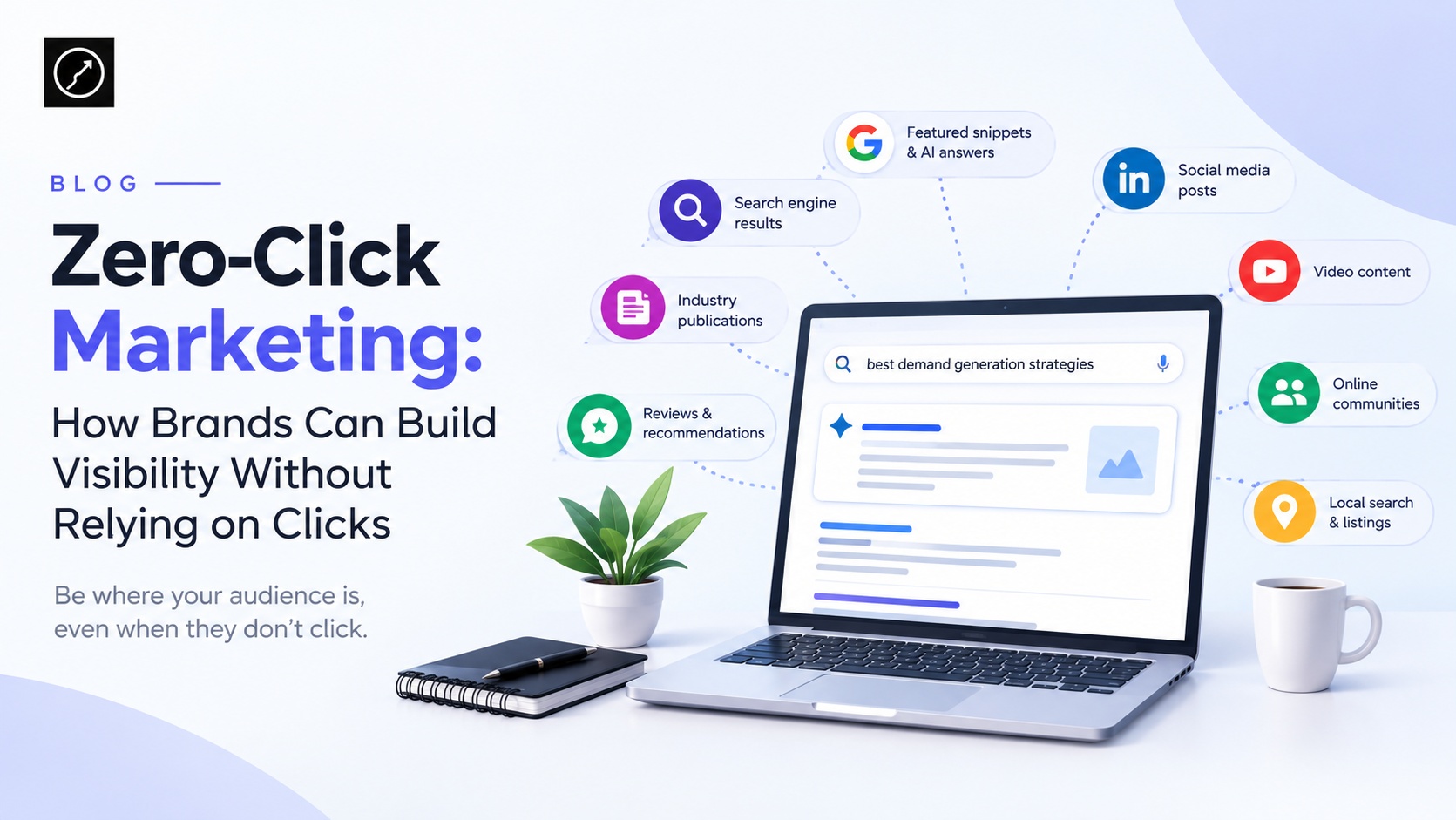
Search engines, social platforms, AI-powered search experiences, and content platforms are increasingly answering questions directly within their own interfaces. A potential customer may discover your brand, learn something useful, compare options, and even develop purchase intent without ever visiting your website.
This is the rise of zero-click marketing.
For businesses, this doesn’t mean clicks no longer matter. It means that clicks are no longer the only indication that marketing is working.
Brands now need to build visibility, credibility, and demand even when the audience doesn’t immediately leave the platform where they discovered them.
What Is Zero-Click Marketing?
Zero-click marketing is a strategy focused on getting your brand, expertise, products, or services in front of potential customers without requiring them to click through to your website.
The interaction can happen directly within:
- Search engine results
- AI-generated search responses
- Featured snippets
- Knowledge panels
- Social media feeds
- LinkedIn posts
- YouTube results
- Online communities
- Business listings
- Review platforms
- Industry publications
For example, someone searching for:
“How can a SaaS company reduce customer acquisition costs?”
may see an answer directly in the search results.
They may not click anything.
However, if your company is visible in that answer—or your content is used as a source—the person has still encountered your brand.
That exposure can contribute to awareness and future demand.
Why Zero-Click Visibility Matters
Traditional analytics can make this type of exposure difficult to measure.
A visitor who lands on your website can be tracked through tools such as analytics platforms and CRM systems. But someone who sees your brand in a search result and later types your company name directly into Google may not appear to have interacted with the original content.
This creates a measurement gap.
A modern marketing strategy therefore needs to consider multiple stages of the customer journey:
Visibility → Awareness → Consideration → Engagement → Conversion
A click is only one possible step within that journey.
Zero-click visibility can help brands:
- Build awareness
- Establish subject-matter authority
- Increase brand recall
- Influence purchase research
- Support branded search demand
- Strengthen trust
- Reach audiences earlier in the buying journey
- Generate future website and sales activity
The goal isn’t to eliminate clicks.
The goal is to create demand even when a click doesn’t happen immediately.
Where Does Zero-Click Marketing Happen?
Zero-click interactions can happen across almost every major digital channel.
1. Search Engine Results
Search engines increasingly provide direct answers to users.
Depending on the query, users may encounter:
- Featured snippets
- FAQs
- Definitions
- Local business information
- Product information
- Reviews
- Related questions
- Images
- Videos
- AI-generated summaries
This creates an opportunity for businesses to optimize content not just for traditional rankings, but for visibility within the search experience itself.
Instead of asking only:
“How do we rank #1?”
marketers should also ask:
“How can our brand become part of the answer?”
2. AI Search and Answer Engines
AI-powered search is creating another layer of zero-click discovery.
Users increasingly ask conversational questions such as:
“What are the best demand generation strategies for a B2B SaaS company?”
Rather than receiving a conventional list of ten blue links, they may receive a synthesized response.
For brands, this creates a new visibility challenge.
Your content needs to be:
- Clear
- Factually useful
- Well structured
- Relevant to specific questions
- Supported by credible information
- Consistent across digital channels
AI visibility should therefore complement—not replace—traditional SEO.
3. Social Media
Social platforms are also zero-click environments.
A user can consume an entire piece of marketing content without visiting the company’s website.
Consider a LinkedIn post explaining:
“Five mistakes B2B companies make when building a demand generation strategy.”
A prospect may read the post, save it, share it with a colleague, and remember the company—all without clicking the website link.
That is still valuable marketing exposure.
For B2B brands in particular, social content can play an important role in building familiarity before a prospect enters an active buying cycle.
4. YouTube and Video Platforms
Video can generate significant zero-click engagement.
A viewer may:
- Watch an educational video
- Learn about a problem
- Discover a brand
- Hear a product recommendation
- Subscribe to the channel
without visiting the company’s website.
This makes educational video content particularly useful for businesses with complex products or services.
5. Local Search
For local businesses, zero-click discovery can happen directly through business listings.
A potential customer may search for:
“digital marketing agency near me”
and make a decision based on:
- Business name
- Reviews
- Rating
- Location
- Services
- Photos
- Opening hours
- Business description
The user may call or visit the business without ever going to its website.
This is why local search optimization should extend beyond website SEO.
How to Build a Zero-Click Marketing Strategy
Zero-click marketing shouldn’t be treated as a separate channel.
It should be incorporated into your broader SEO, content, social media, demand generation, and brand strategy.
Step 1: Identify the Questions Your Audience Is Asking
Start with customer problems rather than keywords alone.
For example, a cybersecurity company might discover questions such as:
- How does data security work in the cloud?
- What is confidential computing?
- How can companies secure AI workloads?
- What should businesses consider before moving sensitive data to the cloud?
These questions can become the foundation for content designed to capture discovery across search, social, and AI platforms.
Step 2: Create Content That Answers Questions Quickly
Zero-click environments reward clarity.
Instead of burying the answer beneath five paragraphs of introduction, provide a concise explanation early in the content.
Then expand on it.
A useful structure is:
Question → Direct answer → Explanation → Example → Supporting evidence → Next step
This format can work particularly well for informational content.
Step 3: Build Topic Authority
Publishing one article about a topic isn’t enough to establish meaningful authority.
Develop a connected content ecosystem.
For example, a demand generation agency could create content covering:
- What is demand generation?
- Demand generation vs. lead generation
- B2B demand generation strategies
- Demand generation funnel
- Demand generation KPIs
- Paid demand generation
- Content-led demand generation
- How to measure pipeline contribution
Together, these resources create broader topical coverage.
Step 4: Optimize for Multiple Discovery Surfaces
Don’t create content exclusively for Google.
Repurpose valuable insights across the channels where your audience spends time.
One research project could become:
Website:
A detailed guide.
LinkedIn:
Five short insights.
YouTube:
An educational video.
Email:
A practical newsletter.
Social:
Short-form statistics and observations.
Sales enablement:
A useful customer-facing resource.
This approach allows one core idea to generate multiple opportunities for zero-click visibility.
Step 5: Make Your Brand Recognizable
Visibility without brand recognition has limited value.
Whenever possible, associate useful information with a recognizable brand identity.
That means maintaining consistency in:
- Brand terminology
- Visual identity
- Subject-matter expertise
- Author profiles
- Messaging
- Social presence
- Website content
- Third-party mentions
The objective is to make the audience remember who provided the useful information.
Zero-Click Marketing and SEO
Zero-click marketing doesn’t make SEO irrelevant.
Instead, it expands what SEO needs to accomplish.
Traditional SEO often focuses on metrics such as:
- Rankings
- Organic traffic
- Click-through rate
- Backlinks
- Conversions
These remain important.
But businesses should increasingly consider additional visibility indicators, such as:
- Search-result appearances
- Featured-result visibility
- Brand mentions
- Search demand for branded terms
- AI search visibility
- SERP features
- Content citations
- Social engagement
- Direct traffic trends
The important shift is from “traffic as the only outcome” to “visibility as part of the outcome.”
How Zero-Click Marketing Supports Demand Generation
This is particularly relevant for B2B companies.
B2B buyers rarely make purchasing decisions after a single interaction.
A prospect might encounter your brand several times:
- They see your LinkedIn post.
- They encounter your company in a search result.
- Someone recommends your content.
- They see your brand mentioned in an industry publication.
- They search for your company.
- They visit your website.
- They download a resource.
- They eventually speak with sales.
Traditional attribution can struggle to capture the influence of those earlier interactions.
Zero-click marketing helps businesses recognize that demand is often created before measurable conversion activity begins.
What Should You Measure?
The biggest mistake is trying to measure zero-click marketing exclusively through website traffic.
Instead, combine visibility, engagement, brand, and business metrics.
Visibility metrics
- Search impressions
- SERP feature appearances
- AI visibility
- Social reach
- Brand mentions
- Content citations
Engagement metrics
- Saves
- Shares
- Comments
- Video views
- Engagement rate
- Returning audiences
Brand metrics
- Branded search volume
- Direct traffic
- Brand mentions
- Share of search
- Brand-related engagement
Business metrics
- Marketing-qualified leads
- Sales opportunities
- Pipeline influenced
- Customer acquisition
- Revenue contribution
The right measurement framework depends on the business model, buying cycle, and marketing objectives.
Common Zero-Click Marketing Mistakes
Focusing Only on Traffic
A reduction in clicks doesn’t necessarily mean your content has become less valuable.
If more information is being consumed directly in search results, the interaction may simply be happening somewhere other than your website.
Traffic should therefore be evaluated alongside visibility and business outcomes.
Creating Content Only for Search Engines
Content written exclusively around keywords can struggle to provide genuine value.
Instead, focus on answering real customer questions clearly and comprehensively.
Ignoring Brand Building
A user may remember an answer without remembering the company behind it.
Strong branding helps turn informational visibility into future demand.
Treating Every Channel Separately
SEO, social media, content marketing, paid advertising, and demand generation should reinforce one another.
A consistent message across multiple channels creates more opportunities for repeated exposure.
Chasing Every New Platform
Not every emerging platform deserves investment.
Prioritize the channels where your target customers actually research, learn, compare, and make decisions.
The Future of Zero-Click Marketing
Digital discovery is becoming increasingly fragmented.
Customers can discover brands through search engines, AI tools, social platforms, communities, videos, reviews, podcasts, newsletters, and recommendations.
That means the traditional journey of:
Search → Click → Website → Conversion
is becoming only one part of the customer journey.
The brands that adapt will think beyond website sessions and focus on becoming discoverable wherever their audience is looking for answers.
Zero-click marketing is ultimately not about getting fewer clicks.
It is about understanding that attention, trust, and demand can be created before the click ever happens.
How TheMarketingAlpha Can Help
Building visibility across search, social, content, and demand-generation channels requires more than publishing content consistently.
It requires a connected strategy.
At TheMarketingAlpha, we help businesses build digital marketing programs designed to increase visibility, attract the right audience, and create measurable demand.
Our approach can bring together:
- SEO and organic growth
- Content marketing
- Demand generation
- Paid advertising
- Social media marketing
- Local SEO
- Conversion optimization
- Analytics and performance measurement
The objective is simple: build a marketing engine that creates visibility, engagement, qualified opportunities, and sustainable growth.
If your audience is discovering answers without clicking, your brand still needs to be part of those answers.
TheMarketingAlpha helps businesses turn digital visibility into meaningful growth.
This version is intentionally original in structure and wording, rather than being a find-and-replace version of the Semrush article. I can also turn this into a fully SEO-ready website version with meta title, meta description, target keyword, FAQ schema questions, internal-link suggestions, CTA sections, and image/infographic concepts for TheMarketingAlpha.