Google Search is evolving beyond the traditional list of blue links. With AI-powered experiences, users can ask complex questions, explore recommendations, compare alternatives, and continue their research through conversational follow-up questions.
For businesses that depend on organic search, this evolution introduces a new challenge: how do you maintain visibility when search engines increasingly provide synthesized answers alongside links to websites?
Google AI Mode is an important part of this change.
Rather than simply returning a list of webpages, AI Mode generates responses that combine information from multiple searches and sources. Users can explore a topic in greater depth without repeatedly starting a new search.
For marketers, the opportunity is not to abandon traditional SEO. It is to understand how search behavior is changing and ensure that their websites continue to provide useful, accessible, and credible information.
In this guide, TheMarketingAlpha explains how Google AI Mode works, what it means for organic search, and how businesses can adapt their digital marketing strategies.
What Is Google AI Mode?
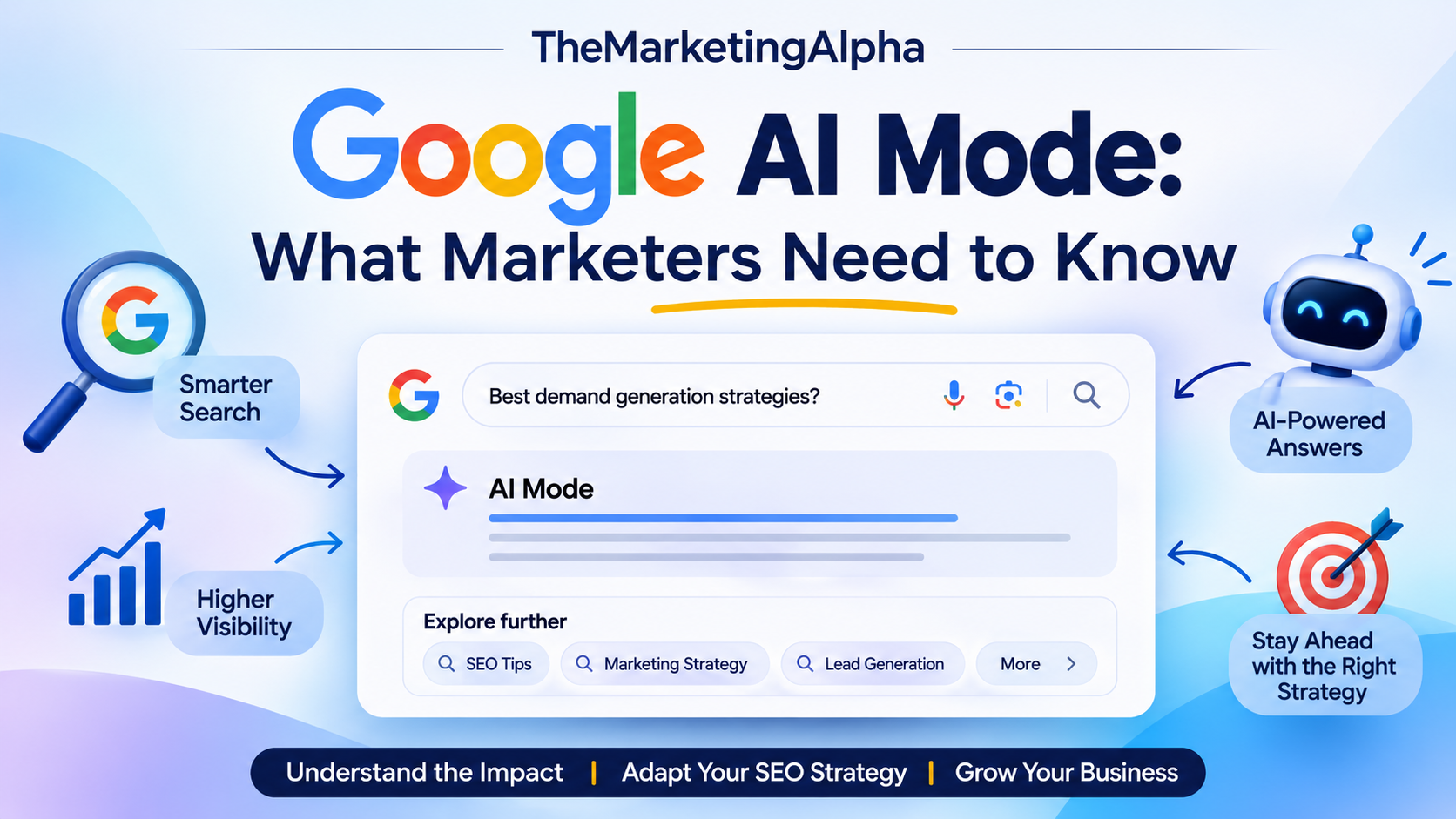
Google AI Mode is an AI-powered search experience that helps users investigate questions, explore topics, and compare options through conversational responses.
Users can submit detailed questions, ask follow-ups, and explore relevant links to learn more. Depending on the available features, searches can also incorporate different input methods, including text, voice, and images.
Consider someone researching digital marketing agencies.
Instead of searching separately for agency services, pricing, specializations, and client experience, the user might ask:
“What should a B2B SaaS company look for when choosing a digital marketing agency, and how should it evaluate potential partners?”
AI Mode can break the question into related subtopics, search for relevant information, and synthesize a response with links that support further research.
This creates a more conversational discovery process.
The important distinction: AI Mode changes how information is presented and explored, but the underlying web remains an important source of information for Google’s search experience.
How Does Google AI Mode Work?
Google explains that AI Mode can use a technique called query fan-out. Instead of relying on one search query, the system can explore multiple related searches across different subtopics and sources.
The process can be understood through four stages.
1. Understanding the Question
The system interprets the user’s question and identifies the information needed to provide a useful response.
For example, a question about choosing SEO services might involve pricing, technical capabilities, reporting, experience, and expected business outcomes.
2. Exploring Related Topics
The system can investigate multiple aspects of the question simultaneously rather than treating every aspect as an entirely separate search.
This helps address more complex research needs.
3. Generating a Synthesized Response
Information from relevant sources is combined into an AI-generated answer intended to address the user’s question.
The response may include supporting links so users can investigate individual sources.
4. Continuing the Research
Users can ask follow-up questions to refine their requirements, explore alternatives, or request additional context.
This makes search more interactive and allows users to move through a research journey conversationally.
AI-generated responses can still contain errors or miss important context. Users should verify important claims against reliable sources.
Google AI Mode vs. Traditional Google Search
Both experiences help users find information, but they present it differently.
| Feature | Traditional Google Search | Google AI Mode |
|---|---|---|
| Primary experience | List of search results and other search features | Conversational, AI-generated responses with links |
| Query style | Often short keyword phrases | Supports detailed questions and follow-ups |
| Information presentation | Users explore individual results | Information may be synthesized from multiple sources |
| Research process | Often involves several separate searches | Can combine related research within a conversation |
| Website discovery | Through search listings and other result features | Through supporting links within AI responses and related search experiences |
| SEO relevance | Fundamental to organic search visibility | Traditional SEO fundamentals remain relevant to eligibility and visibility |
AI Mode does not mean that traditional search results have disappeared. Both experiences can provide opportunities for users to discover websites.
For marketers, the priority is to create content that meets customer needs across different search experiences.
How Google AI Mode Could Change Organic Traffic
One of the biggest questions for marketers is whether AI-powered search will reduce website traffic.
The answer depends on the query, the industry, the user’s intent, and the way Google presents its response.
Some users may find a quick answer sufficient. Others may need to visit a website to verify information, understand a product in greater depth, compare vendors, or take action.
This distinction matters because not every search has the same business value.
Informational Searches
A user searching for a basic definition may find enough information in an AI-generated response.
This could reduce the need to visit several websites for simple questions.
Research-Oriented Searches
Someone comparing marketing platforms, researching a business problem, or evaluating service providers may need more detailed information.
Supporting links can help these users explore relevant resources.
Commercial Searches
Users evaluating products and services may require pricing details, case studies, customer reviews, product demonstrations, and direct contact with a business.
These needs can create opportunities for well-developed commercial pages.
What Should Marketers Do?
Avoid assuming that every AI-generated answer will reduce traffic or that every AI citation will generate a visit.
Instead, analyze how organic impressions, clicks, branded searches, conversions, and qualified leads change over time.
The goal is to understand whether your website is attracting the right audience and contributing to business growth.
Does Google AI Mode Replace SEO?
No. Google states that its existing SEO best practices remain relevant to AI features in Search, including AI Mode and AI Overviews. There are no separate special optimization requirements that guarantee inclusion.
This is an important point for businesses considering an AI search strategy.
Your website still needs to meet Google’s technical requirements for Search and follow its policies. Content should remain useful, reliable, relevant, and created primarily for people.
The most effective approach is to strengthen the SEO foundation while making your content more useful for complex, question-led research.
Technical SEO Still Matters
Make sure search engines can access and understand your important pages.
Priorities include:
- Correct indexation and crawlability
- Logical website architecture
- Descriptive page titles
- Useful internal links
- Mobile usability
- Fast, reliable page experiences
- Appropriate structured data
- Clear and accessible content
Technical improvements do not guarantee that a page will appear in an AI-generated response, but they help maintain the foundation required for search visibility.
Content Quality Remains Essential
Publishing more pages does not automatically improve visibility.
Content should address a specific audience, demonstrate genuine expertise, answer relevant questions, and provide useful information beyond generic summaries.
Authority Requires Credibility
Businesses should support their expertise through original research, customer evidence, expert contributions, credible third-party coverage, and transparent information.
These practices help users evaluate the quality of a company’s claims and experience.
How to Optimize Your Website for Google AI Mode
There is no guaranteed method to make Google AI Mode mention your business. However, several practical improvements can strengthen your website’s overall search readiness.
1. Answer Important Customer Questions Directly
Identify the questions potential customers ask before choosing a product or service.
For a digital marketing agency, these could include:
- What does a demand generation agency do?
- How is demand generation different from lead generation?
- Which SEO services are important for a growing business?
- How should a company evaluate digital marketing ROI?
- What should businesses expect from an SEO audit?
Build useful pages around these questions.
Start each section with a clear answer, then explain the reasoning, provide examples, and link to relevant supporting resources.
2. Create Comprehensive Topic Clusters
Organize related content around your main services and areas of expertise.
For example, a demand generation content cluster could include:
- Demand generation strategy
- Demand generation channels
- B2B lead generation
- Account-based marketing
- Lead nurturing
- Marketing attribution
- Demand generation reporting
A connected content structure helps visitors explore related subjects and gives search engines clearer context about the information on your website.
3. Include Original Insights and Evidence
Avoid relying entirely on generic advice that appears across hundreds of websites.
Where possible, incorporate:
- Original research
- Campaign findings
- First-hand experience
- Customer case studies
- Industry-specific examples
- Expert commentary
- Relevant data and documented results
For example, an article explaining landing-page optimization becomes more useful when it includes a real experiment, explains what was changed, and describes the observed outcome.
Always represent research and results accurately.
4. Improve Content Structure
Organize information so readers can quickly understand the main points.
Use descriptive headings, concise explanations, meaningful lists, comparison tables, and relevant examples.
Structured data can also help search engines interpret supported information when implemented correctly. However, using structured data does not guarantee AI visibility or special placement.
5. Build a Consistent Brand Presence
Your website is one part of your company’s online identity.
Maintain accurate information about your business, services, expertise, and customer experience across relevant platforms.
Credible third-party coverage, reviews, partnerships, and professional contributions can help potential customers evaluate your business.
Focus on genuine reputation building rather than attempting to manufacture mentions.
6. Keep Important Information Current
Review pages containing information that changes frequently, including service descriptions, pricing, product capabilities, industry guidance, and regulations.
Update outdated claims, remove unnecessary repetition, and ensure that important facts remain accurate.
Content freshness should reflect a genuine need for updates rather than changing publication dates without meaningful improvements.
How to Measure SEO Performance in the AI Search Era
Traditional SEO reporting remains important, but marketers should interpret results in the context of changing search experiences.
A useful measurement framework includes four areas.
Organic Search Performance
Use Google Search Console and your analytics platform to monitor:
- Impressions
- Clicks
- Click-through rate
- Average position
- Organic sessions
- Landing-page performance
Compare results over time and investigate changes by query, page, device, and search intent.
Brand Visibility
Monitor branded search demand, relevant third-party mentions, referral traffic, and how your company is represented in important search experiences.
You can also periodically test representative customer questions in AI Mode to understand which sources appear and how your business is described.
Treat these tests as directional observations. AI-generated responses can vary, so a single test is not a reliable measure of overall visibility.
Conversion Performance
Track outcomes that matter to your business, such as:
- Qualified leads
- Demo requests
- Enquiries
- Newsletter subscriptions
- Purchases
- Conversion rate
- Assisted conversions
Traffic is valuable, but it should be evaluated alongside its contribution to business objectives.
Reporting Limitations
AI-influenced discovery may not always be attributed cleanly to a single channel.
A customer might discover a brand during research, return through a branded search, and convert during a later visit.
Use multiple data sources and consistent reporting methods to understand these journeys as accurately as possible.
Common Google AI Mode SEO Mistakes
Mistake 1: Abandoning Traditional SEO
AI-powered search does not eliminate the need for technically sound websites, helpful content, or good user experiences.
Continue investing in the fundamentals.
Mistake 2: Publishing Content Solely to Attract AI Citations
Content created primarily to manipulate an AI system often lacks the depth and relevance that customers need.
Build pages to solve genuine problems first.
Mistake 3: Assuming Structured Data Guarantees Visibility
Structured data can help search engines interpret supported content, but it does not guarantee inclusion in AI-generated answers.
Use it accurately and follow Google’s documentation.
Mistake 4: Measuring Success Only Through Rankings
Rankings are useful, but they do not tell the entire story.
Monitor qualified traffic, branded demand, conversions, and the broader contribution of organic marketing.
Mistake 5: Ignoring the Conversion Experience
Even if users discover your brand through an AI-powered search experience, your website must still help them take the next step.
Make service information clear, explain your value proposition, provide evidence of credibility, and offer relevant calls to action.
A Practical Google AI Mode Strategy for Businesses
Businesses do not need to rebuild their entire marketing program around AI search.
A more effective approach is to prioritize improvements that strengthen existing SEO while supporting more complex customer research.
First, audit your website. Identify technical issues, outdated pages, unclear service descriptions, and content gaps.
Second, map customer questions. Organize topics around the problems customers need to solve before making a decision.
Third, improve your best content. Add useful explanations, original examples, reliable evidence, and relevant internal links.
Fourth, strengthen brand credibility. Invest in thought leadership, digital PR, customer stories, and accurate business information.
Fifth, establish a measurement baseline. Track organic performance, conversions, and selected AI visibility observations before evaluating the results of your changes.
Finally, review and refine. Use performance data and customer feedback to identify the next improvements.
This approach allows your business to adapt to AI-powered search without abandoning the organic growth strategies that already create value.
The Future of Search Is About More Than Rankings
Google AI Mode reflects a broader change in how people research, compare, and evaluate information online.
Users can ask more detailed questions, explore related subjects, and interact with search results conversationally. For businesses, this creates both uncertainty and new opportunities to provide useful information when customers need it.
The right response is not to chase every new AI feature or abandon established SEO practices.
It is to build a website that is technically accessible, genuinely useful, credible, and aligned with customer intent.
At TheMarketingAlpha, we believe sustainable organic growth comes from combining strong SEO fundamentals with a clear understanding of how customers discover and evaluate businesses.
As search evolves, companies that consistently invest in helpful content, technical quality, authority, and measurable marketing outcomes will be better prepared to adapt.
The objective is simple: make your business easier to discover, easier to trust, and easier to choose.
If your business is looking to strengthen its organic visibility and adapt its marketing strategy to evolving search experiences, explore TheMarketingAlpha’s SEO and digital marketing services to identify the opportunities that matter most to your growth.
Frequently Asked Questions
What is Google AI Mode?
Google AI Mode is an AI-powered search experience that provides synthesized responses to questions, supports follow-up conversations, and offers links for further exploration.
How does Google AI Mode affect SEO?
It changes how users discover and consume information through Google Search. Traditional SEO best practices remain relevant, but marketers should also consider how their content answers complex questions and supports deeper research.
Can websites rank in Google AI Mode?
Eligible webpages may appear as supporting links in AI Mode responses. Google does not guarantee inclusion, and meeting technical requirements alone does not ensure that a page will be selected.
Is AEO necessary for Google AI Mode?
Answer Engine Optimization is a useful way to think about making content clear and useful for answer-driven search experiences. However, Google says there are no additional special optimization requirements for appearing in AI Mode beyond the established requirements and best practices for Search.
Will Google AI Mode reduce organic traffic?
The impact varies by query, industry, and user behavior. Some users may find an answer without visiting a website, while others may follow links to investigate a topic further. Businesses should measure actual changes in traffic and conversions rather than assume a uniform effect.
How can businesses monitor AI search visibility?
Review relevant customer prompts periodically, observe whether your website appears in supporting links, and record which competitors and sources are surfaced. Combine these observations with Search Console, analytics, branded search trends, and conversion reporting for a more complete picture.