AI-generated content is entering a new era of transparency. Here’s what Claude’s watermarking approach could mean for SEO, content marketing, publishers, and businesses.
Artificial intelligence has quickly become part of the everyday marketing workflow.
From drafting blog posts and social media campaigns to summarizing research, creating product descriptions, translating content, and developing marketing strategies, AI is now involved in almost every stage of content production.
But a new development from Anthropic is putting an important question back on the table:
Should AI-generated content be identifiable?
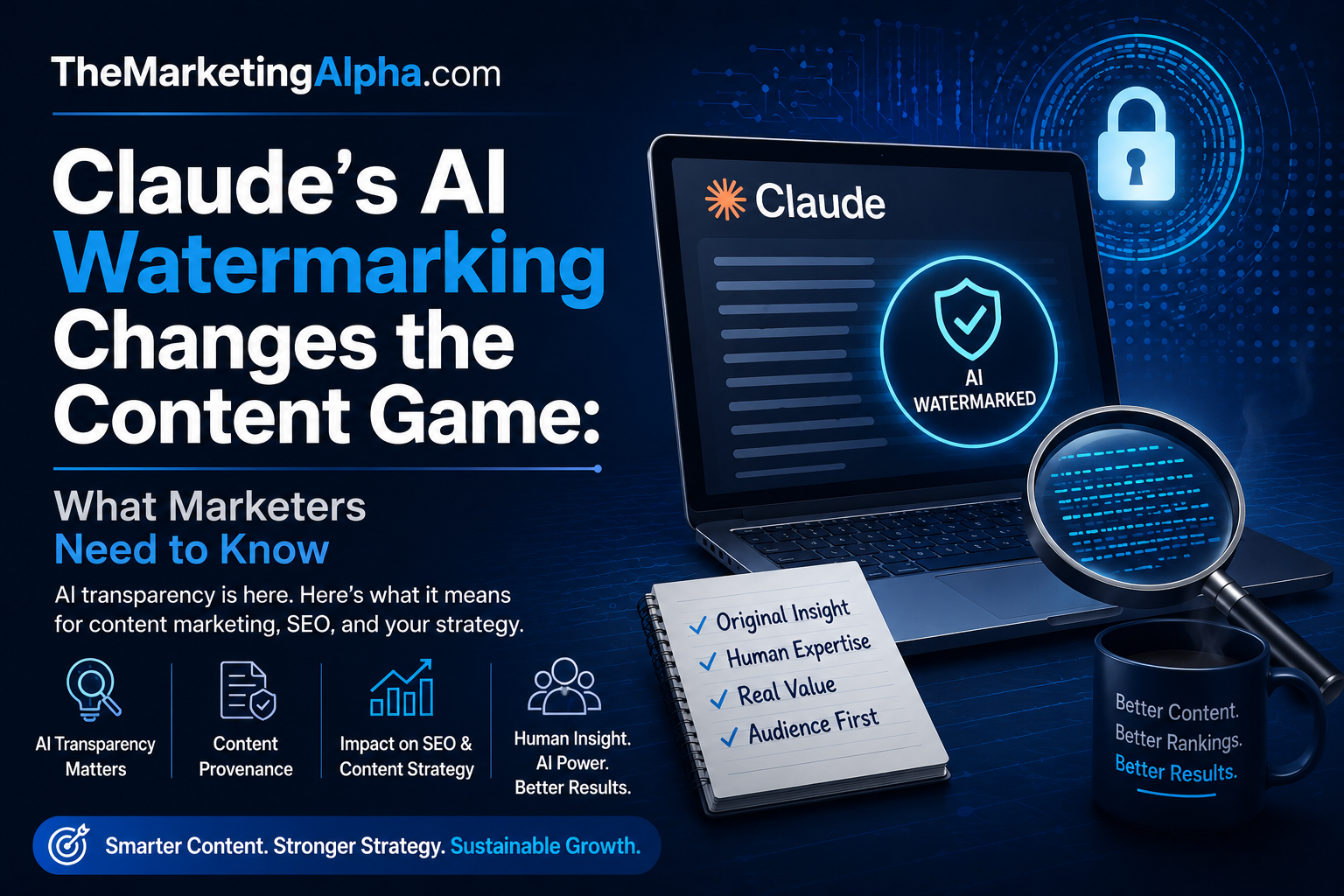
Anthropic has introduced watermarking technology for content produced by Claude. The technology is designed to create an invisible signal within generated text, while files can also carry information indicating their origin.
For marketers, this doesn’t necessarily mean that AI-generated content is about to disappear from search results.
Instead, it signals a broader shift toward AI transparency and content provenance.
Here’s what marketers should understand.
What Is AI Watermarking?
Traditional watermarks are easy to understand: a visible logo, label, or pattern is placed over an image or document.
AI text watermarking works differently.
Rather than adding something visibly identifiable to an article, a watermark can influence the statistical pattern of word or token selection during generation.
To a reader, the content can look completely normal.
The signal exists underneath the surface.
This means that a piece of text generated by an AI system may potentially be identified through statistical analysis, provided the appropriate detection mechanism and conditions exist.
The important distinction is that this doesn’t necessarily mean:
“This sentence was written entirely by AI.”
Instead, a watermark can indicate that an AI system was involved somewhere in the content-production process.
That distinction matters enormously for modern marketing teams.
Why This Matters to Content Marketers
Consider a typical marketing workflow.
A writer creates an article.
They then use Claude to:
- Improve grammar
- Rewrite sections
- Translate the article
- Create an outline
- Summarize research
- Generate alternative headlines
- Refine the introduction
If the final version carries an AI-origin signal, that doesn’t automatically tell us how much of the original work came from a human.
The technology therefore raises an important question:
Does AI detection tell us who actually created the content—or simply whether AI participated in the workflow?
For businesses, that distinction could become increasingly important.
AI Doesn’t Automatically Mean Bad Content
One of the biggest misconceptions surrounding AI content is that:
AI-generated = low quality.
That’s not necessarily true.
The real problem is usually the way AI is used.
A company can produce thousands of generic pages with little original insight, poor research, and no meaningful value for its audience.
It can also use AI as an accelerator for experienced marketers who already understand their customers, industry, positioning, and search intent.
Those are two completely different approaches.
The first is content automation without strategy.
The second is AI-assisted content marketing.
The difference isn’t the technology.
It’s the editorial process behind it.
What About Google Rankings?
This is where marketers are likely to become unnecessarily concerned.
The existence of AI watermarking does not automatically mean search engines will begin penalizing every page that contains AI-generated material.
Search engines have consistently focused more heavily on the quality, usefulness, originality, and intent of content than simply whether a particular tool was involved in producing it.
That means marketers shouldn’t suddenly abandon AI-assisted workflows.
Instead, they should focus on creating content that demonstrates:
- First-hand experience
- Original research
- Useful insights
- Strong topical relevance
- Accurate information
- Clear expertise
- Genuine audience value
- Human editorial oversight
The question shouldn’t be:
“Was AI used?”
It should be:
“Is this content actually worth reading?”
The Bigger Issue: Content Provenance
AI watermarking becomes more interesting when we look beyond SEO.
Imagine an agency promising a client:
“Every article we deliver will be written entirely by humans.”
If AI was used somewhere in the process, watermarking could potentially become relevant to that contractual agreement.
The same could apply to:
- Academic publishing
- Journalism
- Government communications
- Financial reporting
- Legal documentation
- Brand communications
- Public-interest content
As AI becomes embedded into everyday software, knowing where content originated could become increasingly valuable.
AI Detection Has Limitations
There’s another important point marketers shouldn’t overlook.
AI detection is not the same thing as certainty.
Text can change considerably through editing, rewriting, translation, formatting, or other transformations.
A short piece of text may also contain insufficient statistical information to make a confident determination.
This creates a fundamental limitation:
AI detection should not automatically be treated as proof of authorship.
A detector may identify that AI was involved without establishing exactly how much of the content was generated by AI.
That’s why businesses should be cautious about treating detection scores as definitive evidence.
What Marketers Should Do Now
There is no need to panic or completely redesign your content strategy.
Instead, build a better AI-assisted workflow.
1. Keep humans in the loop
AI can accelerate research, ideation, drafting, and editing.
But strategic decisions should remain under human control.
Your marketing team should determine:
- What the audience needs
- What the brand should say
- What differentiates the company
- What evidence supports the claims
- What the final content should communicate
2. Add original expertise
Don’t simply ask AI to rewrite information already available online.
Bring something new to the conversation.
Use:
- Customer interviews
- Internal data
- Expert opinions
- Case studies
- Original surveys
- First-hand experience
- Proprietary research
That’s where content becomes genuinely valuable.
3. Treat AI as a productivity layer
The strongest marketing teams won’t necessarily be the ones generating the most content.
They’ll be the teams that use AI to make their existing processes faster and better.
For example:
Research → AI-assisted analysis → Human insight → Content creation → Editorial review → SEO optimization → Distribution → Performance analysis
AI becomes part of the system rather than the entire system.
4. Establish an internal AI policy
Companies should clearly define how AI can be used.
For example:
Allowed
- Brainstorming
- Research assistance
- Outlining
- Editing
- Summarization
- Translation
Requires review
- Customer-facing claims
- Industry statistics
- Thought leadership
- Technical content
- Legal or compliance-sensitive material
Human ownership
- Brand positioning
- Strategic messaging
- Final editorial approval
- Sensitive communications
This creates accountability without preventing teams from benefiting from AI.
What This Means for SEO Strategy
For SEO teams, the lesson is relatively simple.
Don’t build a strategy around trying to make content appear “less AI.”
Build a strategy around making content more useful.
That means moving away from:
Keyword → AI article → Publish
and toward:
Search demand → Audience problem → Original insight → Expert content → SEO optimization → Distribution → Measurement
That’s a much more sustainable model.
The Future Isn’t Human vs. AI
The debate around AI content is often presented as a competition:
Human content vs. AI content.
That’s probably the wrong way to look at it.
The future of marketing is much more likely to involve human expertise amplified by AI.
AI can help marketers research faster, identify patterns, generate ideas, process information, and produce initial drafts.
Humans bring context, judgment, creativity, experience, empathy, and accountability.
The brands that combine those strengths will have a significant advantage.
Final Takeaway
AI watermarking represents an important development in the evolution of generative AI.
But marketers shouldn’t interpret it as a warning to stop using AI.
Instead, it should encourage better content practices.
Use AI where it improves efficiency.
Use humans where judgment matters.
And most importantly, don’t confuse producing more content with producing better content.
At TheMarketingAlpha, we believe the future of digital marketing isn’t about choosing between AI and human expertise.
It’s about combining both to build smarter, faster, and more effective growth engines.
The winning question isn’t:
“Can AI create this content?”
It’s:
“Can we use AI to create something our audience genuinely finds valuable?”