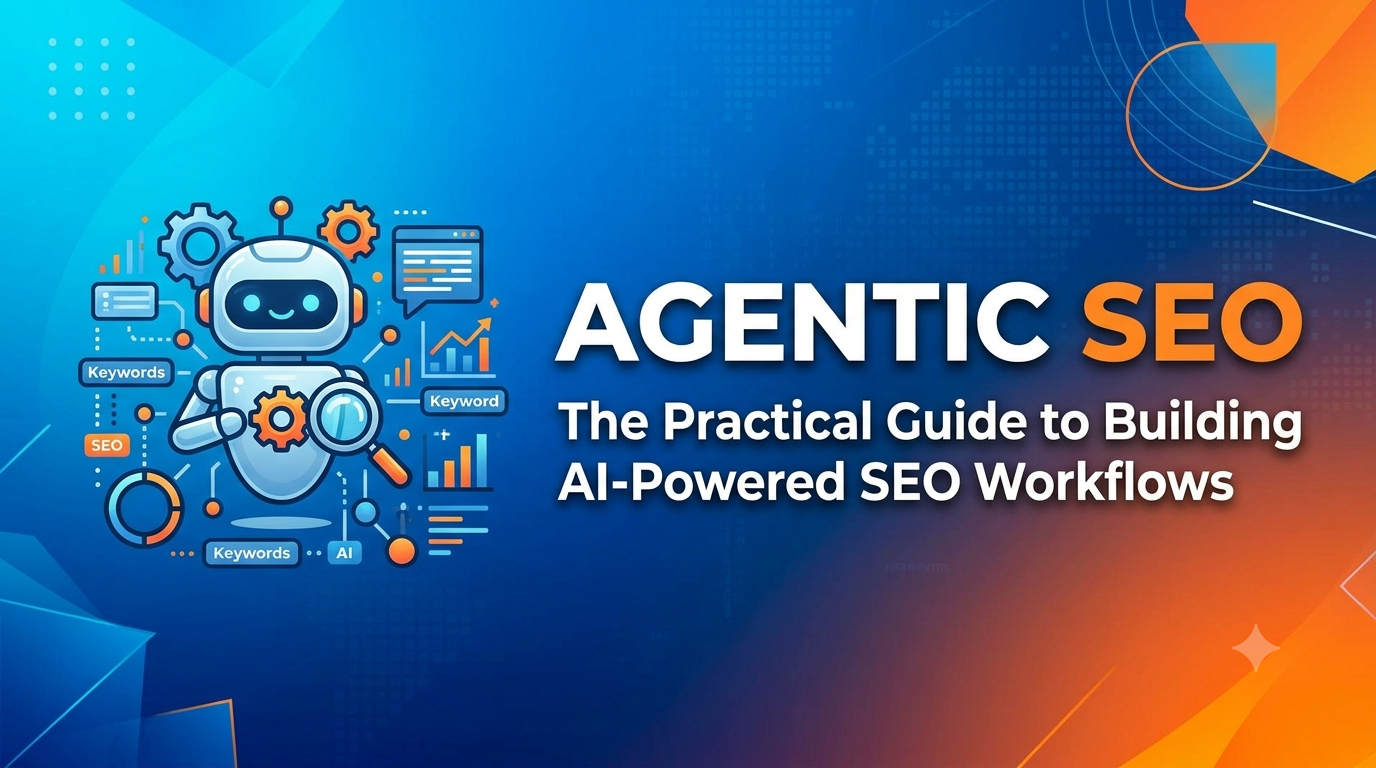
Search optimization used to revolve around dashboards, spreadsheets, crawling tools, keyword lists, and a never-ending queue of tasks.
Then AI changed the way marketers work.
But there is an important difference between using AI for SEO and building an agentic SEO system.
Asking an AI assistant to analyze your keywords is AI-assisted SEO.
Giving an automation platform a fixed set of rules is workflow automation.
Agentic SEO sits somewhere different: you give an AI system a goal, access to relevant data, a defined process, and boundaries for what it can and cannot do. The system can then investigate, connect evidence, make recommendations, and return an actionable output without requiring you to manually assemble every piece of information first.
That shift matters because SEO is not one task. It is a collection of recurring investigations.
Content declines.
Competitors change.
Search demand moves.
Technical problems appear after deployments.
Pages become outdated.
AI-generated search experiences introduce new visibility questions.
And many of these activities require judgment rather than simple automation.
This guide explains how to turn those recurring SEO activities into practical agentic workflows—and where human judgment should remain firmly in the loop.
What is Agentic SEO?
Agentic SEO is the use of AI agents to investigate, analyze, and execute repeatable SEO workflows using live data, predefined methodologies, and defined decision rules.
The important word is workflow.
A generic AI prompt might look like:
“Analyze my website and tell me what I should improve.”
An agentic workflow is considerably more specific.
It might:
- Pull the latest search-performance data.
- Compare it with an earlier period.
- Detect meaningful changes.
- Investigate potential causes.
- Cross-check findings against technical data.
- Separate confirmed evidence from assumptions.
- Recommend an action.
- Escalate decisions that require human approval.
The result is not simply an AI-generated answer.
It is a repeatable process.
That distinction is becoming increasingly important as AI systems move from generating responses to interacting with tools, websites, databases, and other systems. Google itself now describes agentic experiences as systems that can perform tasks on behalf of users, including researching information and interacting with websites.
Agentic SEO is not “put your SEO on autopilot”
One of the biggest misconceptions about agentic SEO is that the objective is to remove humans from the process.
In practice, the better objective is to remove repetitive investigation while preserving human judgment.
An agent can identify that organic traffic fell sharply on a page.
It can discover that rankings also declined.
It can check whether the page remains indexed.
It can compare competitors.
It can identify whether search demand changed.
But the final decision may still belong to an SEO strategist:
Should the page be rewritten, consolidated, redirected, or left alone?
That is where agentic systems become useful rather than blindly autonomous.
Agentic SEO vs. AI-Assisted SEO vs. Traditional Automation
These approaches can look similar from the outside, but they behave differently.
| Approach | How it works | Best suited for |
| Traditional automation | Executes predefined rules | Highly predictable, repetitive tasks |
| AI-assisted SEO | AI helps with analysis or creation | Research, ideation, one-off tasks |
| Agentic SEO | AI investigates using tools, methodology, context, and rules | Recurring SEO analysis requiring judgment |
Consider technical SEO.
A traditional automation might check whether 100,000 URLs return a 200 status code.
An AI assistant might review an exported spreadsheet and explain unusual patterns.
An agentic workflow could combine crawl data, search performance, URL-level context, and predefined business priorities to identify the technical issues that actually deserve attention.
The key difference is not intelligence alone.
It is decision-oriented orchestration.
The Architecture of an Agentic SEO System
A reliable agentic SEO workflow needs more than a powerful model.
Think of the system as six interconnected components.
1. Business context
The AI needs to understand what the website is actually trying to accomplish.
That can include:
- Target audiences
- Primary markets
- Products and services
- Conversion goals
- Priority topics
- Competitor definitions
- Editorial standards
- Brand terminology
- Business-specific SEO priorities
Without this context, an AI can produce technically correct recommendations that are commercially irrelevant.
For example, increasing traffic to a low-intent informational keyword may look positive in an SEO report while doing almost nothing for pipeline generation.
2. Live data
An agent becomes considerably more useful when it can retrieve current information rather than relying on manually pasted exports.
Depending on the workflow, that could include:
- Google Search Console data
- Analytics data
- Search-result information
- Website crawl data
- Keyword rankings
- Backlink information
- Content inventories
- CMS data
- CRM or conversion data
The Model Context Protocol, or MCP, has emerged as one way for AI applications to connect with external tools and data sources. The protocol continues to evolve rapidly, with the July 2026 specification introducing major architectural and authorization changes.
The important principle is simple:
Give the agent access to evidence, not just instructions.
3. A repeatable methodology
This is the part many AI SEO implementations overlook.
A prompt tells an AI what you want right now.
A methodology tells it how the investigation should be performed every time.
For example:
First verify whether the URL is indexed.
Then compare organic clicks.
Then inspect ranking changes.
Then investigate demand.
Then check technical signals.
Only after these checks should a recommendation be made.
That procedure becomes reusable.
When the process improves, you update the methodology once rather than rewriting prompts for every analyst.
4. Decision rules
Not every finding deserves the same response.
A useful agentic SEO system should understand rules such as:
High priority: significant organic loss affecting commercially important pages.
Medium priority: measurable performance change with limited business impact.
Low priority: technical issue with negligible traffic or conversion implications.
You can also define action rules:
- Update
- Consolidate
- Redirect
- Monitor
- Investigate
- Escalate to technical teams
- Require human review
This prevents the AI from treating every SEO issue as equally important.
5. Guardrails
An SEO agent should not have unlimited authority.
A practical system should distinguish between read actions and write actions.
Reading:
- Crawl data
- Analytics
- Rankings
- Search results
- Content inventories
Writing:
- Publishing content
- Editing production code
- Changing redirects
- Updating metadata
- Removing pages
- Modifying robots directives
- Sending outreach
The second category should generally require human approval.
6. Human review
Human involvement is not a failure of automation.
It is part of the design.
AI systems can misinterpret data, overstate confidence, misunderstand business context, or recommend a technically valid action that creates a larger strategic problem.
The strongest workflow is therefore:
AI investigates → AI explains → human decides → system verifies.
8 Agentic SEO Workflows Worth Building
You do not need to automate everything.
Start with workflows that happen repeatedly, consume significant analyst time, and follow a recognizable process.
Here are eight practical use cases.
1. Content Decline Diagnosis
Traffic drops are easy to notice.
Explaining why they happened is harder.
A content-decline agent can monitor important URLs and investigate changes across several dimensions instead of immediately recommending a rewrite.
A useful workflow might examine:
- Organic clicks
- Impressions
- CTR
- Average position
- Indexation
- Search demand
- Competing URLs
- Internal links
- Backlinks
- Canonicals
- Recent content changes
The agent then categorizes the likely cause.
For example:
Ranking decline
The page is still relevant, but competitors may have gained visibility.
Demand decline
Search interest has fallen, meaning rewriting the content may not solve the problem.
Technical problem
Indexation, canonicalization, redirects, or another technical condition may explain the decline.
Content overlap
Another page may now be competing for the same search intent.
The important lesson
Do not automate the recommendation before automating the investigation.
A workflow should answer:
What changed? Why did it change? What evidence supports that explanation? What should happen next?
2. Technical SEO Triage
Most technical SEO audits produce more findings than a team can realistically fix.
That creates a prioritization problem.
An agentic technical SEO workflow can turn a large list of issues into a smaller engineering backlog.
Instead of grouping issues only by category, the workflow can group them by root cause and business impact.
For example:
Ten redirect warnings may actually come from one implementation mistake.
Hundreds of duplicate URLs may originate from one CMS configuration.
A collection of broken internal links might all trace back to a single template.
The agent can combine technical findings with traffic, rankings, conversions, and business importance to determine which issues deserve attention first.
A useful output
Each recommendation should contain:
Issue
What is wrong?
Evidence
What data proves it?
Impact
What could happen if it remains unresolved?
Fix
What should be changed?
Acceptance criteria
How will the team know the problem is actually fixed?
This makes an SEO audit much more useful to developers.
3. Competitor Movement Investigation
Competitor tracking often becomes passive reporting.
“Competitor X gained traffic.”
“Competitor Y published 40 pages.”
“Competitor Z gained rankings.”
None of those observations tells you what you should do.
An agentic workflow can go one step deeper.
When a competitor changes significantly, investigate:
- Which URLs changed?
- Which queries drove the movement?
- Was the growth branded or non-branded?
- Did new content cause the increase?
- Did existing content improve?
- Was there a seasonal effect?
- Did search demand change?
- Could the change be caused by a migration or technical event?
- Is the topic strategically relevant to your business?
The output should not simply say:
“Competitor traffic increased.”
It should explain:
“The increase appears concentrated in these topic areas, driven by these pages, with this level of confidence.”
That difference turns competitor monitoring into competitive intelligence.
4. Search Opportunity → Content Brief
Keyword research often starts too late.
A keyword appears in a database, gets assigned to a writer, and only later does someone discover that another page already addresses the same intent.
Agentic SEO can reverse that process.
Before recommending a new article, the workflow can ask:
- Do we already cover this topic?
- Is there an underperforming page that should be improved instead?
- Are multiple URLs competing for the same intent?
- What questions are associated with the topic?
- What audiences search for it?
- What does the current search landscape look like?
- What evidence is missing from existing content?
- Does the topic align with the business objective?
The final decision could be one of four paths:
Create
Build a new page.
Update
Strengthen an existing page.
Consolidate
Merge overlapping pages.
Do nothing
The opportunity does not justify another piece of content.
That last answer is important.
An agent should be allowed to recommend no action.
5. Internal Linking and Orphan-Page Discovery
Internal linking is one of the most repetitive SEO activities—and therefore an excellent candidate for agentic workflows.
An agent can examine:
- Important pages
- Existing internal links
- Anchor text
- Contextual relationships
- Orphan pages
- Pages receiving little internal authority
- Pages with strong rankings that could support other URLs
The key is not to maximize the number of links.
It is to identify useful relationships.
A good system should ask:
“Would a reader naturally want to visit the destination from this sentence?”
That keeps internal linking useful for people rather than turning it into a purely mechanical SEO exercise.
6. Content Portfolio Decisions
Large websites eventually accumulate hundreds or thousands of URLs.
At that scale, “update everything” is not a strategy.
An agentic content portfolio workflow can classify URLs according to performance and business value.
Possible decisions include:
| Decision | Meaning |
| Keep | Performing or strategically important |
| Refresh | Useful but needs improvement |
| Consolidate | Overlaps with another URL |
| Redirect | Better represented elsewhere |
| Remove | Little value and weak evidence for retention |
| Investigate | Data is inconclusive |
The important addition is the investigate category.
SEO teams often feel pressure to force every URL into a binary keep/delete decision.
Real data is rarely that simple.
A page with declining traffic may still generate leads.
A page with low traffic may support a critical conversion journey.
A page with strong backlinks may deserve preservation.
Agentic systems should surface those conflicting signals rather than hiding them.
7. AI Visibility and Citation Analysis
Search is expanding beyond traditional blue links.
AI search experiences can generate answers using information gathered from multiple sources. Google describes its generative search systems as using retrieved web content to ground responses, while also emphasizing that foundational SEO and high-quality content remain important.
That creates a new SEO research question:
When AI systems answer questions about my category, which sources are they using—and where is my brand absent?
An AI visibility workflow can organize prompts by:
- Topic
- Search intent
- Buying stage
- Audience
- Product category
- Competitor
- Question type
Then analyze:
- Which brands are mentioned
- Which domains are cited
- What types of sources appear repeatedly
- What evidence those sources provide
- Which publishers influence the conversation
- Where your brand is missing
This should not become a race to manufacture mentions.
Google explicitly warns against pursuing artificial mentions or producing low-value content designed primarily to manipulate generative search visibility.
Instead, use the data to identify genuine information gaps.
Perhaps the market needs a benchmark.
Perhaps customers need original research.
Perhaps reviewers lack technical documentation.
Perhaps industry publications are missing an important comparison.
The goal is to create something worth citing.
8. SEO Regression Monitoring After Releases and Migrations
Some of the most expensive SEO problems begin after something “finished successfully.”
A website migration launches.
A developer deploys a new template.
A navigation system changes.
A CMS is upgraded.
A new JavaScript framework is introduced.
The page still loads.
But SEO signals may have changed underneath it.
An agentic regression workflow can compare a pre-release state with a post-release state across:
- HTTP status codes
- Redirects
- Canonicals
- Robots directives
- Sitemap inclusion
- Internal links
- Rendered content
- Metadata
- Indexability
Instead of saying:
“Something changed.”
It can classify changes into:
Expected
The change matches the approved release.
Unexpected
The change was not planned.
Incorrect implementation
The intended change happened, but the implementation does not match requirements.
That turns SEO monitoring into a release-control process rather than a post-launch emergency.
How to Build Your First Agentic SEO Workflow
Do not begin by trying to create an autonomous SEO department.
Start with one workflow.
A practical starting process looks like this.
Step 1: Choose a repetitive problem
Good candidates include:
- Content decline
- Technical triage
- Competitor monitoring
- Content briefs
- Internal linking
- Content inventory management
- AI visibility research
- Migration monitoring
Choose something your team already performs regularly.
Step 2: Document the human process
Before asking AI to automate it, write down how an experienced SEO actually performs the analysis.
Ask:
- What data do they look at?
- What do they check first?
- What causes them to investigate further?
- Which signals override other signals?
- What mistakes do inexperienced analysts make?
- What decisions always require approval?
If the process cannot be explained, it probably should not be automated yet.
Step 3: Connect the right data
Use the minimum number of integrations necessary.
For example:
Content decline
Search Console + analytics + crawl data
Competitor analysis
Search data + ranking data + competitor pages
Technical triage
Crawler + analytics + search performance
AI visibility
Prompt datasets + search results + cited-source analysis
MCP can be useful when an AI environment needs structured access to external tools, but the specific implementation should be reviewed against the current protocol and connector documentation because the ecosystem is evolving quickly. (Model Context Protocol Blog)
Step 4: Turn the methodology into a reusable skill
Create a documented procedure containing:
- Purpose
- Inputs
- Required data
- Ordered investigation steps
- Decision criteria
- Exceptions
- Output format
- Confidence rules
- Human approval requirements
Think of this as the operating manual for the agent.
Step 5: Define the output before building the workflow
Do not ask an agent for a vague “SEO analysis.”
Specify exactly what the final report should contain.
For example:
| Field | Purpose |
| URL | Object being investigated |
| Finding | What changed |
| Evidence | Why the finding is credible |
| Likely cause | Working explanation |
| Confidence | Strength of evidence |
| Business impact | Why it matters |
| Recommended action | What should happen |
| Approval required | Whether human confirmation is needed |
This dramatically improves consistency.
A Practical Agentic SEO Prompt Framework
Once the workflow is defined, the actual prompt can become surprisingly short.
A useful structure is:
Objective
What needs to be investigated?
Scope
Which website, URLs, markets, or topics are included?
Context
What business priorities should influence the analysis?
Method
Which documented workflow should be followed?
Evidence
Which tools and datasets should be treated as sources of truth?
Constraints
What must not be changed or assumed?
Output
What format should the final result use?
Escalation
Which decisions require human approval?
The prompt should tell the agent what to do now.
The methodology, context, and guardrails should already exist elsewhere.
The Guardrails Every SEO Agent Should Have
The more powerful the workflow becomes, the more important the controls become.
A practical agentic SEO system should follow several principles.
1. Evidence before assumptions
If the required data is missing, say so.
Do not invent an explanation.
2. Separate facts from hypotheses
“Clicks declined 34%” is evidence.
“Google penalized the page” is a hypothesis unless there is evidence supporting it.
3. Show confidence
Not every AI conclusion is equally reliable.
4. Keep production systems read-only by default
Allow analysis before allowing changes.
5. Require approval for irreversible actions
Deleting pages, publishing content, changing redirects, or modifying production code should not happen silently.
6. Maintain an audit trail
Store what the workflow saw, what it concluded, and what action was ultimately taken.
7. Allow “no action” as an outcome
Sometimes the right SEO decision is to leave a page alone.
How to Measure Whether Agentic SEO Is Actually Working
Do not measure success only by how sophisticated the AI system sounds.
Measure operational outcomes.
Time to insight
How long did the analysis take before and after automation?
Analyst hours saved
How much manual investigation disappeared?
Recommendation acceptance rate
How often do humans agree with the system’s recommendations?
False-positive rate
How often does the agent flag issues that turn out not to matter?
Resolution time
How quickly can teams move from detection to action?
Coverage
What percentage of the website can now be monitored consistently?
Business impact
Does the workflow ultimately contribute to traffic quality, leads, conversions, revenue, or visibility?
The strongest agentic SEO systems should improve both efficiency and decision quality.
When Agentic SEO Is the Wrong Tool
Not every SEO task needs an AI agent.
If the process is perfectly deterministic, traditional automation may be faster and more reliable.
For example:
“Check whether these URLs return a 404.”
That is not a particularly interesting agentic problem.
A script can do it.
Likewise, if a task has no repeatable methodology, adding an AI agent may simply introduce complexity.
Agentic SEO works best in the middle:
Recurring work + multiple data sources + defined methodology + some level of judgment.
That is where it can create disproportionate value.
The Bigger Shift: From SEO Tools to SEO Systems
The most important development in agentic SEO is not another AI feature.
It is the movement from tools to systems.
Traditional SEO software tells you:
“Here is the data.”
AI-assisted SEO tells you:
“Here is what the data might mean.”
Agentic SEO aims to go further:
“Here is what changed, here is the evidence, here are the possible explanations, here is the recommended action, and here is where a human needs to make the decision.”
That is a fundamentally different operating model.
And it does not replace SEO fundamentals.
Google’s current guidance is clear that foundational SEO practices, crawlability, valuable content, technical accessibility, and people-first information remain important for visibility in generative search experiences. There is no special AI markup that guarantees inclusion.
The opportunity is to make those fundamentals easier to monitor and act upon at scale.
A Simple 30-Day Roadmap for Agentic SEO
You do not need to redesign your entire SEO operation.
Week 1: Identify
Choose one repetitive workflow and document how your team currently performs it.
Week 2: Connect
Give the workflow access to the minimum data required to perform the investigation.
Week 3: Test
Run the agent against historical cases where the correct outcome is already known.
Compare its findings with human analysis.
Week 4: Operationalize
Add guardrails, define approval steps, standardize the output, and begin using the workflow on live work.
Only after the workflow proves reliable should you consider adding another.
Final Takeaway
Agentic SEO is not about asking AI to “do SEO.”
It is about turning repeatable SEO investigations into evidence-driven systems.
The most effective approach combines:
Business context
so the AI understands what actually matters.
Live data
so decisions are based on current evidence.
Documented methodology
so the process remains consistent.
Decision rules
so recommendations reflect business priorities.
Guardrails
so automation does not become uncontrolled execution.
Human judgment
so strategic decisions remain accountable.
For marketing teams, that creates an important opportunity.
Instead of spending most of your time collecting data, checking reports, and repeating the same investigations, your team can spend more time interpreting evidence, making strategic decisions, and creating work that moves the business forward.
That is the real promise of agentic SEO.
Not replacing the SEO strategist.
Giving the strategist a system that can investigate with them.
TheMarketingAlpha can serve as the framework for building that next generation of data-driven SEO workflows—where AI handles repeatable analysis and marketers stay focused on strategy, creativity, and growth.