Artificial intelligence is no longer just changing the tools marketers use. It is changing how people discover information, evaluate brands, create content, make purchases, and interact with companies.
That distinction matters.
The first wave of AI marketing was largely about productivity: generate a blog post, summarize a report, create an image, write an ad, or automate a repetitive task.
The next wave is much broader.
AI is becoming part of the customer journey itself.
People can ask an AI system to research a product, compare vendors, summarize reviews, recommend solutions, create content, and increasingly take action on their behalf. At the same time, marketing teams are using AI to automate production, build internal tools, analyze customer signals, and redesign workflows.
Google itself now provides guidance for optimizing websites for generative AI features in Search, while emphasizing that traditional SEO fundamentals, useful content and strong user experiences remain important.
Gartner’s 2026 research similarly frames AI-driven search as an evolution of the broader discovery journey rather than a simple replacement for conventional search.
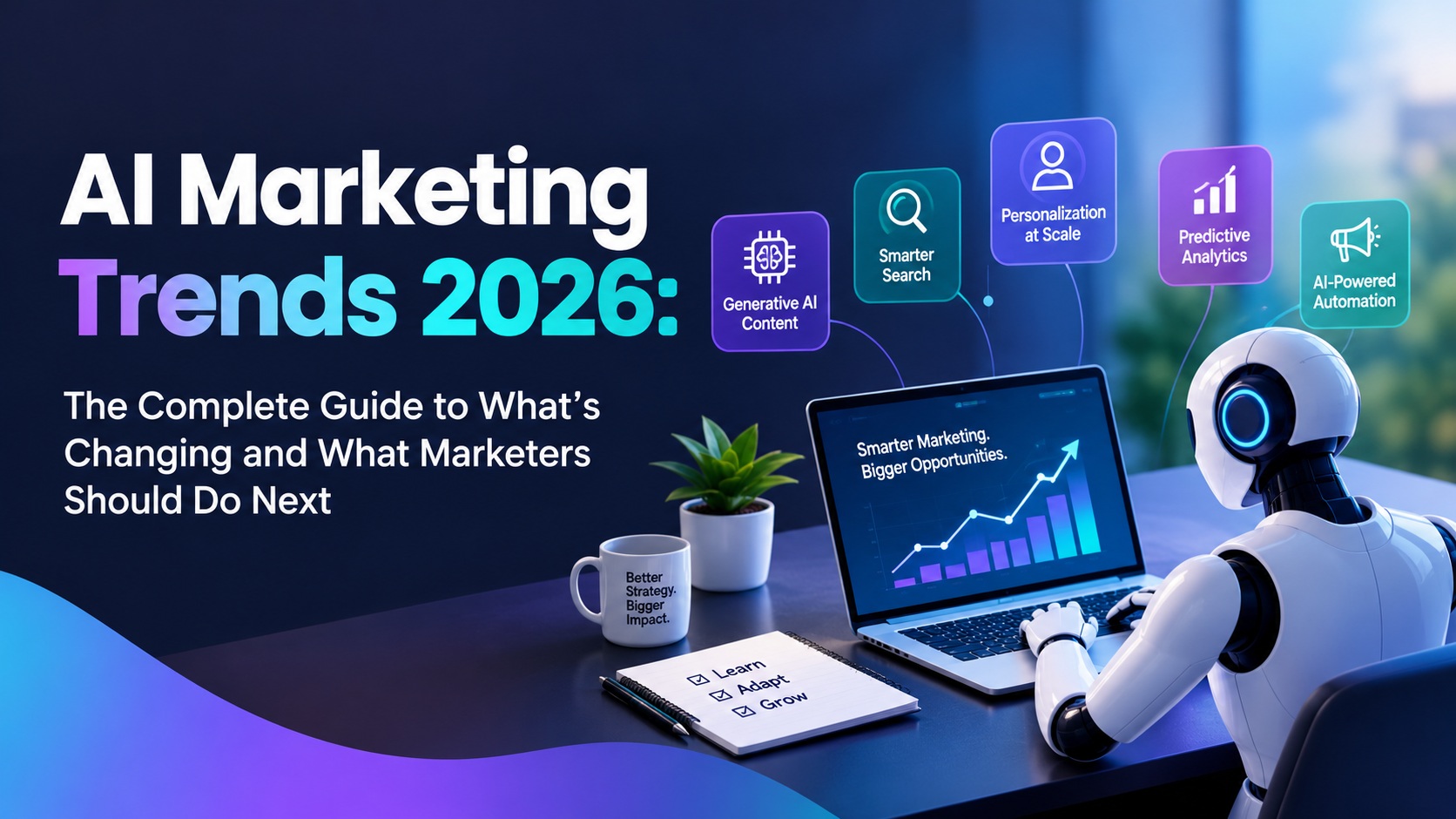
This guide explores the most important AI marketing trends shaping 2026 and, more importantly, what marketers can actually do about them.
The State of AI Marketing in 2026
The biggest change is happening at the intersection of search, content, automation and decision-making.
Traditional marketing was built around a relatively familiar sequence:
Search → Website → Content → Conversion
The emerging AI-driven journey can look very different:
Question → AI research → Comparison → Recommendation → Action
That creates a new challenge for brands.
It is no longer enough to ask:
“How do we rank?”
Marketers increasingly need to ask:
“How do we become a useful, trusted source when an AI system is answering the question?”
And eventually:
“How do we make our brand, products and information understandable to the agents making decisions on behalf of customers?”
That shift is behind many of the trends below.
1. AI visibility is becoming a new layer of search marketing
For years, SEO revolved around rankings.
You optimized pages for keywords, improved technical performance, earned links and tried to move from page two to page one.
AI search changes the unit of visibility.
A brand may now appear inside an AI-generated answer without receiving a conventional organic click. Conversely, a company can have strong traditional rankings but still be absent from an AI-generated recommendation.
This has created growing interest in terms such as:
- AI visibility
- Answer Engine Optimization (AEO)
- Generative Engine Optimization (GEO)
- LLM optimization
- AI search optimization
Gartner’s 2026 research describes the emerging need to integrate SEO, AEO and GEO rather than treating them as completely separate disciplines.
Google’s own documentation also makes an important point: there isn’t a separate set of secret ranking requirements for appearing in its generative AI experiences. The fundamentals still matter — useful content, crawlability, strong page experience, relevant information and people-first content.
What changes for marketers?
Your content strategy needs to optimize for retrievability and quotability, not just rankings.
That means creating content that:
- answers specific questions clearly
- uses concrete facts and examples
- establishes topical authority
- demonstrates first-hand expertise
- cites credible sources
- provides original insight
- uses clear headings and structure
- gives AI systems enough context to understand entities, relationships and claims
The practical takeaway
Think beyond:
“Can Google rank this page?”
Start asking:
“Could an AI system confidently use this page to answer a customer’s question?”
That is a much more useful content test in 2026.
2. AI-generated content is becoming normal — but generic content is becoming easier to ignore
The debate around AI-generated content has moved on.
The important question is no longer simply whether AI was involved in producing a piece of content.
The bigger question is:
Did the content add something useful?
Google’s current guidance explicitly focuses on quality and value rather than banning the use of generative AI itself. At the same time, Google’s spam policies prohibit scaled content abuse, including large quantities of low-value pages generated primarily to manipulate search visibility.
That distinction is increasingly important.
AI can help a marketer research topics, develop outlines, analyze customer questions, summarize material, generate variations and accelerate production.
But simply increasing the number of pages published doesn’t create authority.
In fact, when thousands of companies can generate reasonably polished AI copy, polished AI copy becomes a commodity.
The competitive advantage moves elsewhere.
What will differentiate content?
Original research.
First-hand experience.
Proprietary data.
Expert commentary.
Unique examples.
Strong opinions supported by evidence.
Real customer stories.
Original frameworks.
Useful tools and resources.
That is why the future of AI-assisted content is not necessarily “more content.”
It is better inputs and more distinctive outputs.
A better AI content workflow
Instead of:
Prompt → Draft → Publish
build a process like:
Research → Expert input → AI-assisted production → Human review → Original analysis → Fact checking → Publish → Measure
AI becomes part of the editorial system rather than a substitute for editorial judgment.
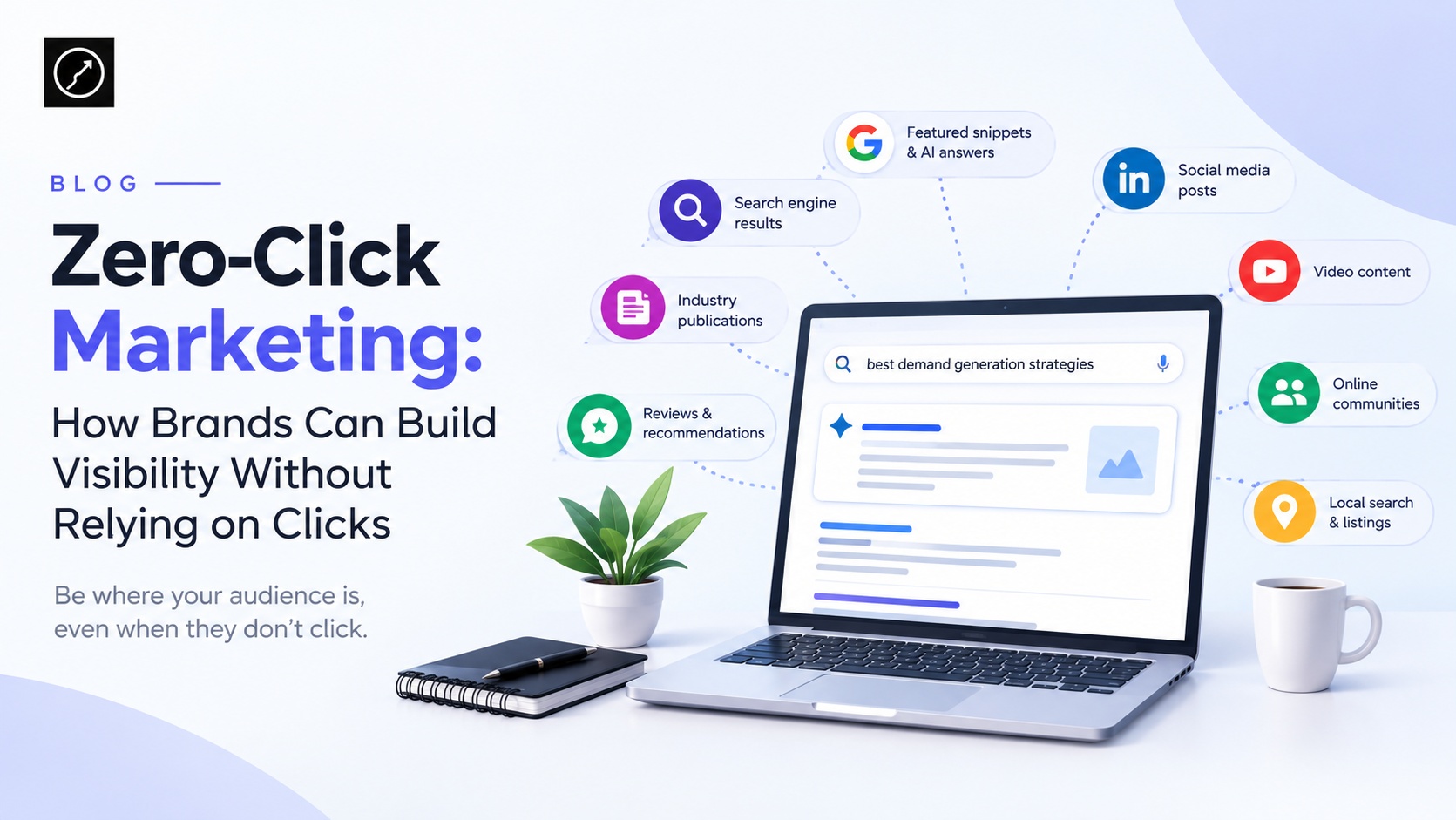
3. Search is becoming increasingly zero-click and answer-first
One of the biggest changes facing organic marketing is that users do not always need to visit a website to get an answer.
Google’s AI experiences are designed to provide more information directly within Search, while other AI platforms can synthesize answers from multiple sources.
That creates a fundamental measurement problem.
A user may discover your brand, read information sourced from your website and become familiar with your company without ever generating a measurable referral session.
Gartner highlighted this problem in September 2026, noting that AI-powered answer engines are creating more “zero-click” experiences and making conventional demand signals harder to observe.
Independent research also points to substantial changes in click behavior when AI-generated summaries appear in search results. For example, one large 2026 analysis of 300,000 keywords found a significant reduction in click-through rate for the top organic result when an AI Overview was present.
What this means for marketers
Traffic can no longer be the only proxy for visibility.
A stronger measurement framework should consider:
Traditional visibility
- rankings
- impressions
- organic clicks
- conversions
AI visibility
- brand mentions
- inclusion in AI-generated answers
- citations
- recommendation frequency
- appearance for high-value questions
Brand demand
- branded search
- direct traffic
- branded conversions
- sales-assisted conversions
- customer research behavior
The goal isn’t to abandon SEO.
It is to recognize that SEO is becoming one part of a larger discovery ecosystem.
4. AI agents are turning search into action
The next evolution of AI search is not simply better answers.
It is taking action.
AI agents are increasingly being designed to browse websites, compare products, complete tasks and make decisions based on instructions and permissions.
This is particularly visible in commerce.
Mastercard’s September 2026 research describes AI agents as increasingly capable of searching, comparing, deciding and transacting within boundaries defined by users.
Checkout.com’s 2026 research similarly reports that large numbers of merchants are already experimenting with agentic commerce and that merchants expect AI-driven commerce to materially reshape how brands compete.
That changes the marketing question again.
A brand once optimized experiences for a human visitor.
Now it may need to optimize information and infrastructure for both:
Humans and machines acting on their behalf.
What could agent-friendly marketing look like?
Product information needs to be structured and unambiguous.
Pricing and availability need to be machine-readable.
Policies need to be easy to understand.
Product attributes need consistency.
Reviews and reputation signals become increasingly important.
Checkout and authentication need to work within evolving agent-based experiences.
Brand information needs to be consistent across the web.
This could create an entirely new layer of digital experience optimization.
Call it Agent Experience Optimization if you like.
The terminology may change.
The underlying shift will not.
5. Marketers can now build their own tools
Software development used to create a clear divide between marketers and engineers.
Need a custom analytics dashboard?
Talk to engineering.
Need a content research workflow?
Build a ticket.
Need a small internal application?
Wait for development resources.
AI-assisted development has significantly lowered that barrier.
Marketers can now use AI coding assistants and low-code or no-code platforms to create lightweight tools tailored to specific workflows.
These might include:
- content scoring systems
- keyword clustering tools
- competitor monitoring dashboards
- campaign calculators
- content brief generators
- internal research assistants
- reporting automation
- lead qualification workflows
- data-cleaning utilities
The interesting change is not simply that marketers can “code with AI.”
It is that the cost of experimentation is falling.
A marketing team can test an idea without committing to a full software project.
What this means for marketing technology companies
The build-versus-buy decision is becoming more complicated.
A generic feature that can be recreated internally may not be a strong differentiator.
Software companies increasingly need to provide value that is difficult to replicate through a simple AI-built tool:
- proprietary datasets
- strong integrations
- workflow depth
- reliability
- governance
- security
- collaboration
- scale
- domain expertise
The new competitive question becomes:
What can we provide that a marketer cannot easily recreate in an afternoon?
6. Attribution is becoming less complete
Marketing attribution was never perfect.
A person could see a social post, read a review, search the company later and convert weeks afterward.
The analytics platform might credit only the final interaction.
AI makes this harder.
A buyer might ask an AI system:
“What are the best enterprise cybersecurity platforms?”
The AI might summarize several companies.
The user then searches for one of those brands directly.
Later, they visit the website and request a demo.
The analytics system sees:
Organic search → Demo
But the actual journey was:
AI recommendation → Brand awareness → Search → Website → Conversion
The AI interaction may never appear in the company’s analytics.
This is why conventional attribution is becoming less capable of explaining influence.
Gartner has specifically highlighted the growing gap between measurable clicks and the less visible ways AI affects demand and customer journeys.
The response should not be to abandon measurement
Instead, expand it.
Track:
- branded search growth
- direct traffic
- assisted conversions
- AI mentions
- citations
- referral traffic from AI platforms
- share of voice in AI answers
- customer surveys asking “How did you hear about us?”
- sales-team observations about AI-driven discovery
In other words:
Measure both the click and the influence surrounding the click.
7. Synthetic UGC and AI-created creative will reshape content production
AI-generated video, avatars, voices and synthetic user-generated content are moving from experimentation into practical marketing workflows.
The attraction is obvious.
Traditional creative production can require:
- creators
- filming
- editing
- reshoots
- localization
- approvals
- multiple production cycles
AI can dramatically reduce the cost and time required to produce variations.
That makes high-volume experimentation easier.
A brand could test dozens of creative concepts across:
- audiences
- languages
- formats
- offers
- hooks
- platforms
But this trend comes with an important warning.
Scale is not the same thing as credibility.
As synthetic content becomes easier to create, audiences may become more sensitive to content that feels artificial, repetitive or deceptive.
Trust, disclosure and authenticity therefore become strategic considerations.
The goal isn’t simply to produce more content.
It is to use AI to increase the number of useful creative experiments while maintaining brand consistency and credibility.
8. Marketing teams are becoming more cross-functional
AI is making old departmental boundaries less meaningful.
Consider AI search visibility.
It can depend on:
Content
Does the company publish useful answers?
SEO
Can search engines and AI systems discover the content?
Digital PR
Do authoritative third-party websites mention the company?
Brand marketing
Are people actively searching for the brand?
Product marketing
Are product facts and use cases clearly documented?
Engineering
Can crawlers and AI systems access the site effectively?
Data
Can performance be measured?
No single team owns the complete outcome.
That means AI marketing is increasingly becoming an operating model problem, not just a content problem.
Gartner’s current marketing research similarly emphasizes organizational changes, AI-ready data and content governance, and closer integration across traditional marketing functions.
The implication
Marketing teams need fewer disconnected AI experiments and more connected systems.
For example:
SEO + Content + PR + Product + Data + Engineering
can work together around a shared visibility objective rather than optimizing isolated channel metrics.
9. Trust becomes a marketing differentiator
There is another trend running underneath all of these developments:
People still need reasons to trust what AI tells them.
This is easy to overlook.
More AI-generated information does not automatically mean more confidence.
Gartner’s research found significant consumer skepticism toward AI-powered search results, with 53% of surveyed consumers saying they distrust or lack confidence in the reliability and impartiality of AI search and summaries.
That creates an interesting opportunity for brands.
In a world where producing information is increasingly cheap, credible information becomes more valuable.
Signals that can strengthen trust include:
- named experts
- original research
- transparent methodology
- citations
- first-hand experience
- clear product documentation
- independently verifiable claims
- consistent brand information
- customer evidence
- transparent AI usage
The brands that simply publish the most AI-generated material may not be the brands that earn the most trust.
10. AI marketing roles are evolving from execution to systems thinking
AI does not simply change the tools marketers use.
It changes what marketers are expected to do.
A marketer who once spent hours manually producing a report can increasingly automate the production step.
That creates room for higher-value work:
- designing workflows
- defining business logic
- validating outputs
- developing proprietary processes
- connecting data sources
- evaluating AI performance
- managing brand consistency
- creating experiments
- interpreting results
The role is gradually shifting from:
“How do I produce this?”
to:
“How should the system produce this reliably?”
That is a much bigger change.
The most valuable AI marketing skills may therefore sit at the intersection of:
Marketing + data + automation + strategy + critical thinking
rather than in prompt writing alone.
What These AI Marketing Trends Mean for Your Strategy
The individual trends matter, but the bigger opportunity lies in connecting them.
A modern AI marketing strategy can be organized around five layers.
Layer 1: Discoverability
Make your brand easy to find across traditional search and AI-powered discovery.
Focus on:
- SEO
- AEO
- GEO
- structured content
- technical accessibility
- third-party authority
Layer 2: Authority
Give AI systems and humans reasons to trust your information.
Focus on:
- original research
- expertise
- citations
- customer evidence
- clear authorship
- unique insights
Layer 3: Content systems
Use AI to increase the efficiency of content operations without turning the website into a library of generic pages.
Focus on:
- research workflows
- editorial systems
- content refreshes
- personalization
- multimedia
- human review
Layer 4: Agent readiness
Prepare digital experiences for AI systems that can increasingly browse, compare and act.
Focus on:
- structured product information
- machine-readable data
- clear policies
- reliable APIs and integrations
- permissions
- identity
- transactional infrastructure
Layer 5: Measurement
Expand beyond clicks.
Track:
- organic visibility
- AI visibility
- brand mentions
- citations
- referral traffic
- branded demand
- conversions
- customer-assisted discovery
A Practical 90-Day AI Marketing Plan
You don’t need to rebuild your entire marketing organization overnight.
A better approach is to create a focused 90-day program.
Days 1–30: Establish your baseline
Identify your most important commercial questions.
For example:
- What problems do customers ask AI systems about?
- Which brands are mentioned?
- Which competitors appear repeatedly?
- Which of your pages are already being cited?
- Where are you missing?
- Which search topics generate the most valuable demand?
Create an initial AI visibility benchmark.
At the same time, audit your existing content.
Remove or improve pages that provide little unique value.
Google’s latest guidance strongly favors useful, original content over large volumes of AI-generated pages.
Days 31–60: Build authority
Create content around the questions that matter most to your customers.
Prioritize:
- original research
- strong explainers
- comparison content
- statistics
- expert interviews
- customer examples
- proprietary frameworks
- useful visual assets
Don’t optimize every article for every possible AI query.
Build fewer pieces that are genuinely worth citing.
Days 61–90: Connect content to distribution and measurement
Extend your visibility beyond your own website.
Look at:
- industry publications
- expert commentary
- digital PR
- partner websites
- communities
- podcasts
- social channels
- video
- customer-generated content
Then build reporting around both traditional and AI-driven visibility.
The goal is not simply to determine:
“Did traffic increase?”
It is to understand:
“Where is demand forming, how is our brand appearing, and what ultimately influences revenue?”
The AI Marketing Playbook Is Still Being Written
The most important lesson from AI marketing in 2026 may be that there is no permanent playbook.
Search interfaces will change.
AI agents will become more capable.
Measurement systems will evolve.
New marketing roles will appear.
Old channels will adapt.
New ones will emerge.
But several principles are becoming increasingly clear.
Create information that deserves to be found.
Build expertise that AI systems can recognize and users can trust.
Treat AI visibility as broader than traditional rankings.
Use AI to improve systems, not simply increase content volume.
Prepare websites and products for machine-mediated experiences.
Measure influence, not just clicks.
Keep humans responsible for judgment, accuracy and trust.
The competitive advantage in AI marketing will not necessarily belong to the companies that generate the most content or adopt the most AI tools.
It will belong to organizations that connect great information, strong brand authority, intelligent automation and measurable customer outcomes.
That is the real shift from AI-assisted marketing to AI-native marketing.
Sources and Research Basis
This guide draws on current public research and guidance, including Google Search Central’s documentation on generative AI search and AI-assisted content, Gartner’s 2025–2026 research on AI search and marketing, and 2026 research on agentic commerce from Mastercard and Checkout.com.
Where click-through-rate changes from AI Overviews are discussed, the underlying study is explicitly attributed to the published research rather than presented as original TheMarketingAlpha data.