Search is changing faster than most businesses realize.
For years, the objective of search engine optimization (SEO) was straightforward: create useful content, optimize your website, earn authority, rank higher in search results, and attract visitors.
Today, people are increasingly asking questions directly to AI-powered search and answer platforms.
Instead of scanning ten blue links, a user might ask:
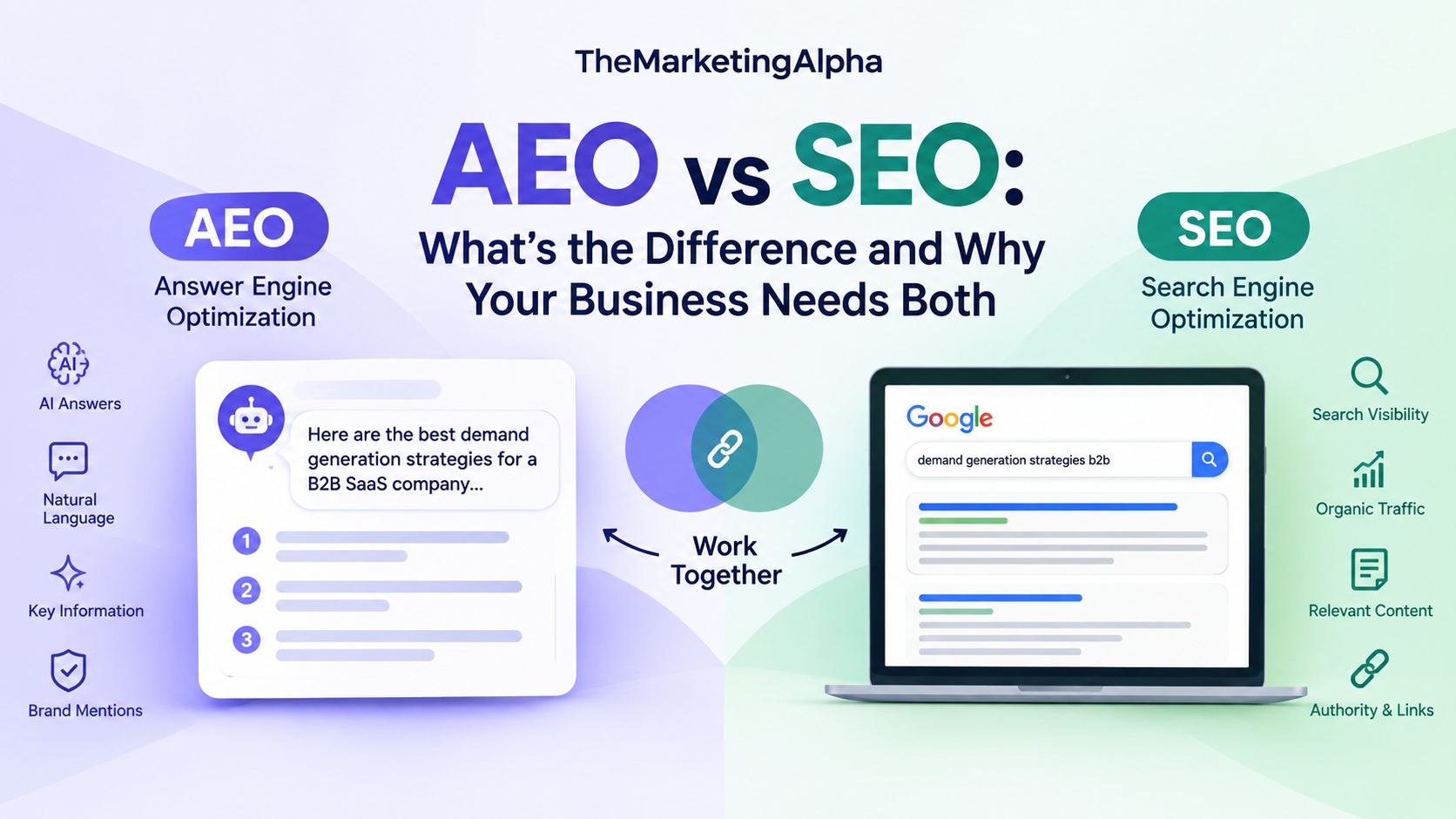
“What are the best demand generation strategies for a B2B SaaS company?”
The answer may be presented as a synthesized response rather than a traditional list of webpages.
This has created a new area of digital marketing: Answer Engine Optimization (AEO).
But does AEO replace SEO?
Not really.
For most businesses, the more practical approach is to understand how the two disciplines overlap, where they differ, and how they can work together.
What Is SEO?
Search Engine Optimization (SEO) is the practice of improving a website and its content so that it can appear prominently in traditional search results.
SEO typically involves:
- Keyword research
- Search intent analysis
- On-page optimization
- Technical SEO
- Content development
- Internal linking
- Digital PR and link acquisition
- Website performance
- Structured data
- User experience
- Authority building
The ultimate objective is to make your website more discoverable when people search for information, products, or services.
For example, a company offering marketing services might optimize content around searches such as:
- Demand generation services
- B2B marketing agency
- SaaS marketing strategy
- Lead generation services
- Digital marketing services
A strong SEO strategy helps those pages become eligible for visibility in conventional search experiences.
What Is AEO?
Answer Engine Optimization (AEO) focuses on making information easy for answer engines and AI-powered search experiences to understand, retrieve, summarize, and potentially cite.
Instead of concentrating exclusively on:
“How do I rank this page?”
AEO asks:
“How can my brand become a useful answer when someone asks a relevant question?”
For example, imagine a prospect asks an AI assistant:
“What should a B2B SaaS company look for when choosing a demand generation agency?”
An answer engine may synthesize information from multiple sources and provide a concise response.
AEO aims to increase the likelihood that your expertise, content, company, or brand is represented within those answer experiences.
AEO vs SEO: The Core Difference
The easiest way to understand the distinction is to look at the primary search experience each one addresses.
| Area | SEO | AEO |
|---|---|---|
| Primary objective | Improve visibility in search results | Improve visibility in generated answers |
| Main environment | Search engines | AI and answer-driven search experiences |
| User behavior | Search, scan, compare and click | Ask, read, evaluate and follow up |
| Content emphasis | Relevance, depth and search intent | Clear, direct and extractable answers |
| Important signals | Technical health, relevance, authority and links | Authority, clarity, relevance, corroboration and structured information |
| Typical measurement | Rankings, impressions, clicks and organic traffic | Mentions, citations, answer visibility and brand presence |
| Conversion path | Search result → website → conversion | AI answer → research → website or later brand interaction |
The distinction doesn’t mean that SEO and AEO operate independently.
In many cases, they share the same foundation.
Why SEO Still Matters for AEO
A common misconception is that the growth of AI search makes traditional SEO irrelevant.
That’s not how marketers should approach the transition.
A website still needs to be:
- Accessible
- Crawlable
- Relevant
- Well structured
- Informative
- Trustworthy
- Technically sound
Research published in 2026 continues to describe substantial overlap between traditional search visibility and visibility in AI-generated answers, although the exact relationship varies by platform.
That means the fundamentals you’ve already invested in through SEO aren’t wasted.
Instead, AEO expands the scope of the visibility problem.
Where AEO Goes Beyond Traditional SEO
While SEO provides an important foundation, optimizing for answer experiences introduces additional considerations.
1. Write Answers Before Explanations
AI systems need to understand what a page is saying.
Instead of beginning an article with several paragraphs of background, consider answering the primary question immediately.
For example:
What is demand generation?
Demand generation is a marketing strategy designed to create awareness, interest, and qualified demand for a company’s products or services across multiple channels.
The rest of the section can then explain the concept in greater depth.
This structure benefits humans as well as machines.
2. Organize Content Around Questions
Traditional keyword targeting often begins with:
“What keyword should we target?”
AEO encourages marketers to also ask:
“What questions does our audience need answered?”
For a B2B cybersecurity company, this could include:
- What is data security?
- How does encryption protect sensitive information?
- What is confidential computing?
- How should enterprises secure AI workloads?
- What is the difference between encryption at rest and encryption in use?
- What security controls are important for regulated industries?
These questions can become the foundation for content clusters.
3. Build Topic Depth Instead of Isolated Articles
Publishing dozens of unrelated blog posts doesn’t necessarily demonstrate expertise.
A stronger approach is to build topic ecosystems.
Suppose your business specializes in demand generation.
One central topic could be:
B2B Demand Generation
Supporting content might cover:
- Demand generation strategy
- Demand generation channels
- Demand generation vs lead generation
- Paid demand generation
- Content-led demand generation
- Account-based marketing
- B2B lead nurturing
- Demand generation metrics
- Demand generation attribution
The result is a more comprehensive knowledge base around a specific subject.
4. Use Clear Definitions
AI systems need to distinguish between related concepts.
Consider the difference between:
SEO
and
AEO
and
GEO
and
AI search optimization
If a page uses these concepts interchangeably without defining them, the content can become difficult to interpret.
Create clear definitions before expanding into more complicated explanations.
This also improves the experience for readers who are encountering the topic for the first time.
5. Demonstrate First-Hand Expertise
Generic content is increasingly easy to produce.
Real experience is harder to replicate.
Businesses should incorporate:
- Original research
- Proprietary data
- Customer examples
- Expert commentary
- First-hand observations
- Original frameworks
- Case studies
- Experiments
- Industry analysis
For example, rather than publishing another generic article about conversion optimization, a marketing agency could publish:
“What We Learned After Testing Five B2B Landing Page Structures Across 20 Campaigns.”
That provides information that is substantially more distinctive than another generic list of conversion tips.
6. Strengthen Your Brand’s Digital Footprint
Your website isn’t the only place where your brand exists.
Potential customers encounter your business through:
- Industry publications
- Reviews
- Social networks
- YouTube
- Podcasts
- Partner websites
- Communities
- News articles
- Guest contributions
- Customer stories
- Professional discussions
This broader ecosystem can contribute to how people—and potentially AI systems—understand your company.
That makes brand authority increasingly important.
AEO Isn’t Just About Your Website
This is one of the biggest differences marketers need to understand.
Traditional SEO often concentrates heavily on optimizing your own website.
AEO requires marketers to think about the entire information ecosystem surrounding the brand.
Consider a SaaS company.
Its website says:
“We are an industry-leading platform.”
But independent sources say:
“The company is primarily used by enterprise organizations for X.”
A prospective customer may encounter both descriptions.
The second provides external context that isn’t controlled entirely by the brand.
This is why digital PR, thought leadership, reviews, customer stories, and third-party coverage can become important components of an AI visibility strategy.
SEO and AEO Should Work Together
Rather than treating AEO and SEO as competing strategies, businesses can build a combined search visibility framework.
Think of it this way:
SEO helps you build discoverability.
AEO helps you build answer visibility.
Brand authority helps reinforce both.
A practical strategy might therefore look like:
Technical SEO → High-quality content → Topic authority → Digital PR → Brand mentions → AI visibility → Demand generation
This creates a much broader approach to organic growth.
How to Create Content for Both SEO and AEO
A page can be designed to serve both search engines and answer engines.
Here’s a practical framework.
Step 1: Identify the Core Search Intent
Understand what the user actually wants.
Don’t create content around a keyword simply because it has search volume.
Determine whether the user wants to:
- Learn
- Compare
- Research
- Solve a problem
- Find a product
- Evaluate vendors
- Make a purchase
Step 2: Map Related Questions
Once the primary intent is identified, list the questions surrounding it.
For example:
Primary topic: Demand generation
Related questions:
- What is demand generation?
- How does demand generation work?
- What are the best demand generation channels?
- What is the difference between demand generation and lead generation?
- How do you measure demand generation?
- How much does demand generation cost?
These questions can become your content architecture.
Step 3: Give Direct Answers
Don’t make readers search through 2,000 words to find the answer.
Lead with the answer.
Then provide:
- Explanation
- Context
- Examples
- Data
- Supporting evidence
- Practical recommendations
This creates content that works for both quick-answer consumption and deeper research.
Step 4: Add Evidence
Where possible, support claims with:
- Original research
- Statistics
- Customer examples
- Expert opinions
- Industry reports
- First-party data
Evidence increases the usefulness of the content and gives readers a reason to trust it.
Step 5: Connect Related Content
Use internal links to build relationships between related topics.
For example:
Demand Generation
→ Demand Generation Strategy
→ B2B Lead Generation
→ Account-Based Marketing
→ Paid Advertising
→ Content Marketing
→ Marketing Attribution
This helps users navigate deeper into the subject while creating a coherent topical structure.
How to Measure AEO
Traditional SEO provides familiar metrics:
- Organic impressions
- Rankings
- Click-through rate
- Organic sessions
- Conversions
- Backlinks
AEO requires additional measurement.
Businesses can monitor:
- AI brand mentions
- AI citations
- Presence for priority prompts
- Competitor mentions
- Share of AI visibility
- Sentiment in AI-generated responses
- Referral traffic from AI platforms
- Branded search growth
- Assisted conversions
One important difference is measurement methodology.
There isn’t a single universal equivalent of a traditional search ranking report for every AI platform. Current AEO research recommends repeated prompt testing and monitoring because AI-generated answers can vary across systems and sessions.
Therefore, avoid treating one AI response as definitive evidence of visibility.
Look for patterns over time.
A Practical AEO + SEO Strategy for 2026
Businesses can organize their strategy into six areas.
1. Technical Foundation
Make sure search engines and AI systems can access and understand your website.
Focus on:
- Crawlability
- Indexation
- Site architecture
- Page speed
- Mobile usability
- Structured data
- Clean URLs
- Internal linking
2. Search Intent
Create content based on real customer questions and problems.
3. Content Quality
Prioritize useful, specific and evidence-based content over publishing volume for its own sake.
4. Authority
Build credibility through:
- Backlinks
- Expert contributions
- Digital PR
- Reviews
- Partnerships
- Original research
- Customer stories
5. AI Visibility
Regularly test important customer questions across relevant AI search experiences and document:
- Which brands appear
- Which sources are cited
- What information is being surfaced
- Where competitors appear
- Which questions your brand is missing from
6. Conversion Strategy
Don’t stop at visibility.
Connect organic and AI discovery to:
- Landing pages
- Lead generation
- Newsletter subscriptions
- Demo requests
- Product trials
- Sales conversations
The objective isn’t simply to be mentioned.
The objective is to turn visibility into meaningful business outcomes.
Common AEO Mistakes to Avoid
Mistake 1: Treating AEO as a Replacement for SEO
AEO and SEO overlap considerably.
Businesses shouldn’t abandon technical SEO, content quality, authority building, or user experience simply because AI search is growing.
Mistake 2: Creating Content Only for AI
Writing unnatural content stuffed with definitions and question-answer formats can make the experience worse for human readers.
Optimize for people first.
Structure the information so machines can understand it as a natural consequence of making it clear for humans.
Mistake 3: Chasing Every AI Platform
Not every platform matters equally to every business.
Identify where your customers actually conduct research.
A B2B software company may have different priorities from an ecommerce retailer or a local service provider.
Mistake 4: Measuring Only Website Traffic
AI-generated answers can influence awareness and consideration before a website visit occurs.
Track the wider customer journey rather than relying exclusively on sessions.
Mistake 5: Publishing Generic AI-Generated Content
AI has made content production easier.
It has also increased the amount of generic information available online.
Your competitive advantage should therefore come from:
Experience + expertise + evidence + originality.
The Future Is Search Everywhere
The biggest change isn’t simply that AI has entered search.
It’s that search itself is becoming distributed across more experiences.
Customers can discover information through:
- Traditional search
- AI-generated answers
- Social platforms
- Video
- Communities
- Reviews
- Voice interfaces
- Brand websites
That means the traditional idea of “ranking on Google” is becoming only one part of a larger visibility strategy.
The brands that adapt their content and authority strategies accordingly can create more opportunities to appear throughout the customer’s research journey.
AEO vs SEO: The Bottom Line
SEO and AEO serve different search experiences, but they share many of the same fundamentals.
SEO focuses on earning visibility in search results.
AEO focuses on earning visibility within answers.
Neither should be treated as an isolated marketing tactic.
For businesses today, the opportunity is to build a unified organic visibility strategy that combines:
Technical SEO + Search Intent + High-Quality Content + Authority + Digital PR + AI Visibility + Conversion Optimization.
At TheMarketingAlpha, we believe the future of organic growth isn’t simply about getting your website to rank.
It’s about making your brand discoverable, understandable, credible and useful wherever your customers are searching for answers.
Because in the AI-first search environment, the question isn’t only:
“Can customers find us?”
It’s also:
“Will our brand be part of the answer?”
Frequently Asked Questions
Is AEO replacing SEO?
No. AEO and SEO address different aspects of modern search visibility and have substantial overlap. A strong SEO foundation can support broader visibility across AI-powered search experiences.
What does AEO stand for?
AEO stands for Answer Engine Optimization. It refers to strategies designed to make content easier for answer engines and AI-powered search experiences to discover, understand, retrieve and potentially cite.
Is AEO the same as GEO?
Not necessarily. The terminology varies across the industry. AEO generally emphasizes optimization for answer-driven experiences, while GEO is often used to describe optimization for generative or AI search experiences. The boundaries aren’t universally standardized.
Does traditional SEO still matter in 2026?
Yes. Technical accessibility, relevant content, authority, website quality and search intent remain important components of organic visibility. Current industry research continues to describe significant overlap between SEO and AI-search visibility.
How can a business improve its AEO?
Start with a technically sound website, create clear answer-focused content, demonstrate genuine expertise, build authority through credible third-party sources, organize content around customer questions, and monitor how your brand appears for relevant AI prompts.
Should small businesses invest in AEO?
AEO can be incorporated into an existing content and SEO strategy rather than treated as a completely separate program. Smaller businesses can start by identifying their most important customer questions and creating genuinely useful, authoritative answers around them.