AI is changing marketing, but the biggest opportunity isn’t letting AI replace marketers. It’s using AI to help marketers research faster, create better campaigns, analyze more data, and make smarter decisions.
From SEO and content creation to demand generation, paid advertising, customer research, analytics, and personalization, AI can now support almost every stage of the marketing funnel.
But there is an important distinction:
AI should accelerate marketing expertise, not replace it.
A marketer still needs to understand the customer, business objectives, positioning, brand voice, and commercial goals. AI simply gives that marketer more leverage.
At TheMarketingAlpha, we see AI as a growth multiplier. When implemented correctly, it can reduce repetitive work, uncover opportunities faster, and help marketing teams spend more time on strategy and execution.
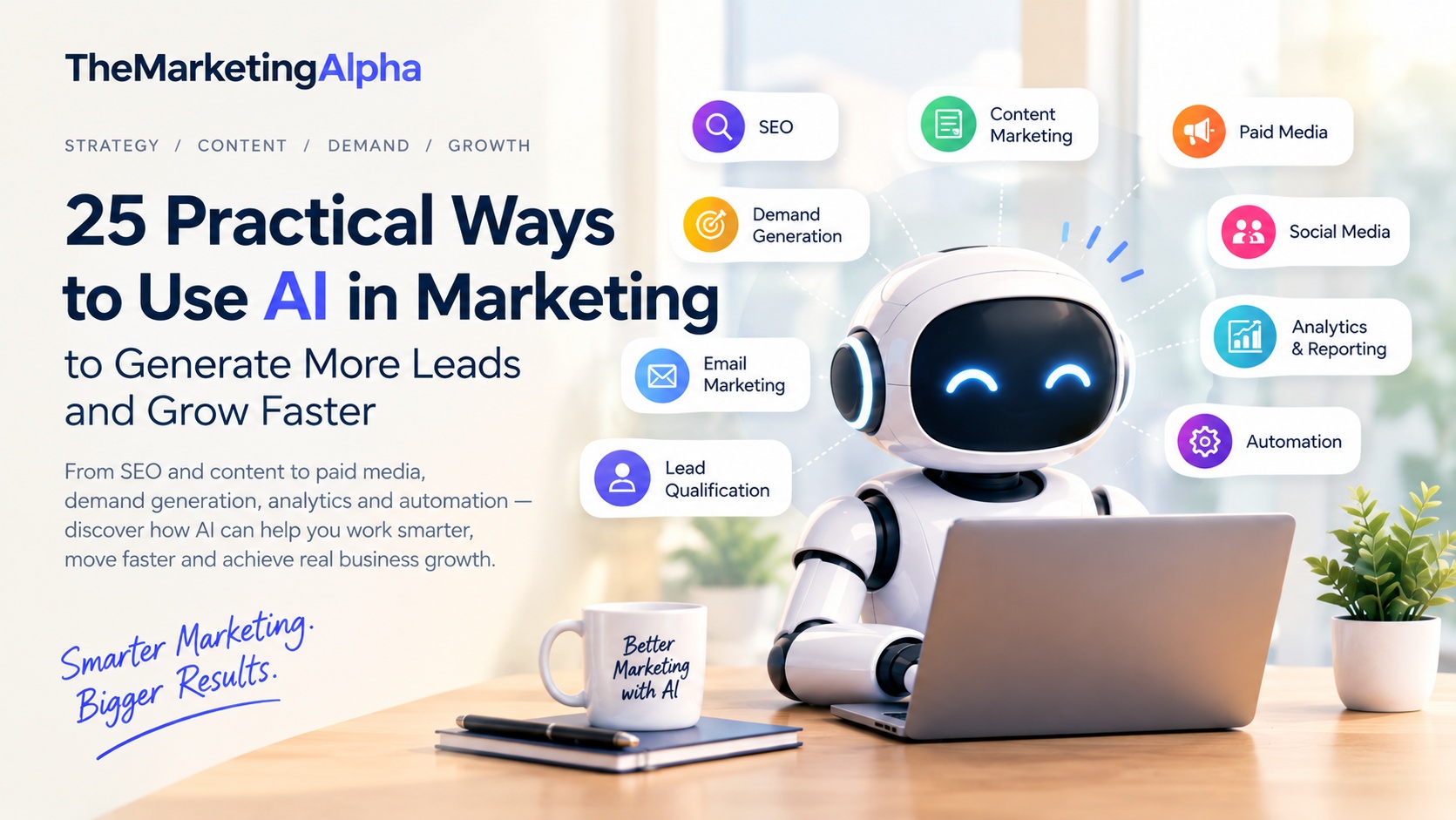
Here are 25 practical ways businesses can use AI across their marketing operations.
1. Accelerate Keyword Research
Traditional keyword research can take hours of spreadsheets, competitor analysis, SERP reviews, and keyword clustering.
AI can speed up the process by helping marketers:
- Generate initial keyword ideas
- Group keywords according to search intent
- Identify related topics
- Build topic clusters
- Discover long-tail opportunities
- Categorize keywords by funnel stage
The important part is not asking AI to blindly generate hundreds of keywords.
Instead, give it your:
Target audience + product + market + customer problem
and use the output as a starting point for proper SEO validation.
2. Find Content Gaps Faster
Your competitors may already be attracting the audience you want.
AI can help analyze competing content and identify areas your website doesn’t cover adequately.
For example, a SaaS company might discover that competitors have content around:
- Product comparisons
- Implementation guides
- Industry use cases
- Pricing questions
- Security concerns
- Integration requirements
These gaps can become opportunities for new content.
The goal isn’t to copy competitors.
It’s to determine:
What does the customer still need to know?
3. Build Better Content Briefs
One of the biggest weaknesses in content marketing is starting with a vague brief.
AI can turn basic information into a structured content brief containing:
- Search intent
- Primary topic
- Secondary topics
- Suggested headings
- Audience questions
- Content objectives
- Conversion opportunities
- Internal-linking opportunities
- Suggested CTA
This gives writers a much clearer starting point.
However, the final brief should still be reviewed by someone who understands the business and audience.
4. Create Content Faster Without Removing Human Expertise
AI can help marketers move from a blank page to a useful first draft much faster.
It can assist with:
- Article outlines
- Landing-page structures
- Email drafts
- Social posts
- Ad variations
- Product descriptions
- Video scripts
- Webinar outlines
But publishing raw AI-generated content isn’t a marketing strategy.
Strong content still requires:
Original insight + experience + evidence + editing + brand perspective.
AI should handle some of the heavy lifting while the marketer remains responsible for quality.
5. Refresh Underperforming Content
Not every page needs to be replaced.
Sometimes an existing article simply needs improvement.
AI can help identify:
- Outdated statistics
- Missing sections
- Weak explanations
- Search-intent mismatches
- Frequently asked questions
- Content that competitors cover better
- Opportunities to improve titles and headings
This can create a systematic content-refresh program.
Instead of asking:
“What should we publish next?”
marketing teams can also ask:
“Which assets do we already have that could perform better?”
6. Generate Better Content Ideas From Customer Problems
Your best content ideas often don’t come from keyword tools.
They come from customers.
Feed AI anonymized information from:
- Sales calls
- Customer interviews
- Support tickets
- Reviews
- Surveys
- FAQs
- Sales objections
- Community discussions
AI can categorize recurring pain points and turn them into potential content themes.
For example:
Customer objection:
“We already have a CRM. Why do we need another platform?”
Potential content:
“When Your CRM Isn’t Enough: 7 Signs Your Marketing Stack Has Outgrown It”
That’s much more commercially relevant than creating content simply because a keyword has search volume.
7. Turn One Piece of Content Into Multiple Assets
A single webinar shouldn’t necessarily produce one recording.
AI can help transform it into:
1 webinar → 1 blog → 5 LinkedIn posts → 3 email ideas → short-video concepts → FAQ content → sales enablement material
This creates a content multiplication system.
The marketing team spends less time recreating information and more time distributing it across channels.
8. Improve Landing Pages
AI can act as a second pair of eyes when reviewing a landing page.
Ask it to evaluate:
- Headline clarity
- Value proposition
- CTA visibility
- Message consistency
- Customer pain points
- Objections
- Trust signals
- Content hierarchy
You can even create different versions for different customer segments.
For example:
Enterprise buyer
vs.
Small-business buyer
may require completely different messaging even when they’re purchasing the same service.
9. Generate Multiple Ad Variations
Paid advertising requires constant experimentation.
AI can help generate variations around:
- Headlines
- Primary copy
- CTAs
- Pain points
- Benefits
- Offers
- Audience-specific messaging
Instead of producing one ad and hoping it works, marketers can build a structured testing matrix.
For example:
| Variable | Version A | Version B | Version C |
|---|---|---|---|
| Hook | Cost reduction | Revenue growth | Efficiency |
| CTA | Book a Demo | Get Started | See How It Works |
| Angle | Problem | Outcome | Transformation |
The advertising platform’s performance data should determine the winner—not AI’s opinion.
10. Personalize Email Campaigns
AI can help marketers move beyond generic email blasts.
Campaigns can be adapted according to:
- Industry
- Company size
- Buyer role
- Funnel stage
- Previous interaction
- Content engagement
- Product interest
For example, someone who downloaded an SEO guide shouldn’t necessarily receive the same follow-up as someone who requested a marketing consultation.
AI can help marketers create these variations at scale.
11. Score and Prioritize Leads
Not every lead deserves the same level of sales attention.
AI can analyze available lead signals such as:
- Company characteristics
- Website behavior
- Content engagement
- Form submissions
- Product interest
- Previous interactions
- Firmographic information
This can help marketing and sales teams identify which prospects deserve faster follow-up.
The result is a move from:
“Follow up with every lead.”
to:
“Prioritize the leads most likely to become valuable customers.”
12. Identify Buyer Intent
AI can help connect seemingly unrelated behavioral signals.
For example:
A prospect might:
- Visit a product page
- Read a comparison article
- Download a guide
- Return several days later
- Visit pricing
- Request a demo
Individually, these actions don’t tell the complete story.
Together, they can indicate strong purchase intent.
AI can help marketers identify these patterns and trigger appropriate actions.
13. Analyze Competitor Messaging
Competitive research isn’t just about comparing features.
AI can help marketers categorize competitor messaging around:
- Target audience
- Value proposition
- Product benefits
- Pricing positioning
- Differentiators
- Customer pain points
- Content themes
- Calls to action
The objective isn’t to imitate competitors.
It’s to discover where your brand can establish a stronger position.
14. Turn Customer Reviews Into Marketing Insights
Reviews contain valuable language customers actually use.
AI can analyze reviews and identify:
- Common benefits
- Complaints
- Feature requests
- Customer expectations
- Emotional language
- Purchase motivations
These insights can improve:
- Website copy
- Ads
- Product positioning
- Email campaigns
- Sales messaging
- Content strategy
Your customers can essentially tell you what your marketing should say.
15. Analyze Marketing Campaign Performance
Marketing teams often have data everywhere:
- Google Analytics
- Search Console
- CRM
- Advertising platforms
- Email platforms
- Social media
- Marketing automation tools
AI can help bring these datasets together and identify patterns.
Instead of simply reporting:
“Traffic increased 18%.”
a better analysis asks:
“Why did traffic increase, which channels contributed to it, and did that additional traffic generate business?”
That’s where AI becomes much more useful than a simple reporting dashboard.
16. Automate Recurring Marketing Reports
Monthly reporting often consumes valuable marketing time.
AI and automation can help assemble:
- Traffic reports
- Lead reports
- Campaign performance
- Conversion rates
- SEO performance
- Paid-media metrics
- Pipeline contribution
The marketer can then spend time interpreting the results rather than manually collecting numbers.
17. Detect Marketing Performance Anomalies
AI can help identify unusual changes in performance.
For example:
- Organic traffic suddenly drops
- CPC increases significantly
- Conversion rate declines
- A campaign suddenly produces unusually strong results
- A landing page receives traffic but no conversions
These alerts allow teams to investigate problems sooner.
18. Improve Social Media Content
AI can help convert one idea into multiple social formats.
For example:
One research report
can become:
- LinkedIn post
- Carousel concept
- Short-form video script
- Twitter/X thread
- Newsletter section
- Sales talking point
But social content still needs human judgment.
A technically correct post can still fail if it doesn’t sound like something a real person would say.
19. Monitor Brand Conversations
AI can help marketers organize mentions of their company across different sources.
It can categorize conversations into:
- Positive sentiment
- Negative sentiment
- Product questions
- Complaints
- Feature requests
- Purchase intent
- Competitor comparisons
This gives marketing teams a clearer understanding of how the market perceives their brand.
20. Improve Sales and Marketing Alignment
Marketing often knows what campaigns generated leads.
Sales often knows why prospects buy—or don’t.
AI can help connect the two.
Analyze sales notes and call transcripts to identify recurring:
- Objections
- Questions
- Competitor mentions
- Buying triggers
- Product concerns
- Reasons for lost deals
These insights can then feed directly into marketing campaigns.
21. Create Customer Personas From Real Data
Instead of inventing personas based on assumptions, AI can help analyze real customer information.
You can identify patterns around:
- Industry
- Job role
- Business size
- Challenges
- Buying motivations
- Objections
- Desired outcomes
The result is a persona based on evidence rather than marketing imagination.
22. Optimize Your Marketing Funnel
AI can help identify where prospects are disappearing.
For example:
10,000 visitors → 1,000 leads → 150 MQLs → 40 SQLs → 8 customers
If the conversion from MQL to SQL is unusually low, that may indicate:
- Poor lead qualification
- Weak messaging
- Incorrect targeting
- Sales follow-up problems
- Misalignment between marketing and sales
AI can help surface these patterns faster.
23. Use AI for Search Beyond Traditional Google Results
Search behavior is changing.
People increasingly use conversational systems to research products, compare solutions, and understand complex topics.
That means businesses should think beyond traditional keyword rankings.
Create content that is:
- Clear
- Structured
- Factual
- Comprehensive
- Easy to understand
- Supported by credible information
- Explicit about the questions it answers
The objective is to make your expertise easy for both humans and modern search systems to understand.
24. Build an AI-Powered Marketing Workflow
The biggest opportunity isn’t using AI for one isolated task.
It’s connecting multiple workflows.
For example:
Research → Content → Distribution → Lead Capture → Qualification → Nurturing → Reporting
AI can support every stage.
A simplified workflow could look like:
Customer data
↓
AI identifies pain points
↓
Marketing creates content
↓
Content generates traffic
↓
Visitors convert
↓
AI helps qualify leads
↓
Sales follows up
↓
CRM data feeds campaign optimization
↓
Performance data improves the next campaign
That’s when AI moves from being a writing assistant to becoming part of a growth system.
25. Use AI as a Marketing Co-Pilot—Not the Marketing Department
This is arguably the most important principle.
AI is extremely good at:
- Processing information
- Finding patterns
- Generating variations
- Summarizing data
- Automating repetitive tasks
- Accelerating research
- Supporting analysis
But humans remain essential for:
- Strategy
- Creativity
- Judgment
- Brand positioning
- Customer empathy
- Business decisions
- Ethical considerations
The strongest marketing teams won’t be the ones that use AI to produce the most content.
They’ll be the teams that use AI to make better marketing decisions faster.
How TheMarketingAlpha Helps Businesses Use AI for Growth
AI shouldn’t be another disconnected tool inside your marketing stack.
It should support a measurable growth strategy.
At TheMarketingAlpha, we approach AI from a business-first perspective.
That means connecting AI with the areas that actually affect growth:
SEO & Organic Growth
Build search strategies designed to increase qualified organic traffic, improve visibility, and create long-term acquisition channels.
Demand Generation
Use audience insights, content, paid campaigns, automation, and analytics to create a predictable pipeline of qualified prospects.
Performance Marketing
Develop and test campaigns across relevant paid channels while using data to continuously improve acquisition efficiency.
Content Marketing
Create content systems that combine AI efficiency with human expertise, original insights, and strong brand positioning.
Marketing Automation
Automate repetitive workflows so marketing teams can focus more on strategy, experimentation, and growth.
Analytics & Optimization
Connect marketing activity with measurable business outcomes—not vanity metrics.
The Future of Marketing Isn’t Human vs. AI
The real competitive advantage is:
Human expertise + AI acceleration + reliable data + strong strategy.
Companies that simply generate more AI content won’t automatically win.
Companies that understand their customers, build differentiated positioning, create genuinely useful content, and use AI to execute and learn faster have a much stronger opportunity.
AI gives marketers leverage.
Strategy determines where that leverage is applied.
And that’s where TheMarketingAlpha comes in.
Frequently Asked Questions
Is AI going to replace marketers?
No. AI can automate many repetitive marketing tasks, but strategy, creativity, customer understanding, positioning, and decision-making still require human expertise.
What is the best way to start using AI in marketing?
Start with repetitive, measurable workflows such as research, content repurposing, reporting, campaign analysis, and lead qualification. Once those workflows are reliable, expand into more advanced automation.
Can AI improve SEO?
AI can accelerate keyword research, content analysis, optimization, internal linking, content refreshes, and reporting. However, SEO still requires strategic judgment and understanding of search intent.
Can small businesses use AI marketing?
Absolutely. Small businesses can use AI to reduce the amount of manual marketing work required and compete more efficiently without needing a large marketing department.
Should businesses publish AI-generated content?
AI-generated content should be reviewed, fact-checked, edited, and enhanced with genuine expertise before publication. Simply producing large volumes of generic content is unlikely to create a strong competitive advantage.
Final Takeaway
AI isn’t a shortcut around good marketing.
It’s a force multiplier for good marketing.
The businesses that benefit most will be the ones that combine AI with a clear understanding of their customers, strong positioning, high-quality content, measurable campaigns, and continuous experimentation.
TheMarketingAlpha helps businesses turn that combination into a practical growth engine.